Saturday, May 16, 2026

Counterpunch: The United States Long War on Cuba: Eric Ross: 15-05-2026: ****************

 May 15, 2026

The United States’ Long War on Cuba

Image by Jasmina Ajkic.

In recent weeks and months, Washington has intensified its long-running campaign of collective punishment against the Cuban people. Escalating sanctions have further tightened the noose of a punitive U.S. blockade that has strangled the island for more than half a century. The resulting “energy starvation” has deepened a manufactured crisis, threatening Cubans’ access to food, water, healthcare, fuel, electricity, and other basic human rights and needs, while intensifying the broader assault on the island’s sovereignty and development.

Since 2017, when the first Trump administration began dismantling the limited normalization measures introduced under Obama, Cuba has once again been subjected to a regime of “maximum pressure” economic warfare. The consequences have been severe. These policies have degraded material conditions across the island, accelerated the exodus of more than one million Cubans, and imposed disproportionate suffering on the country’s most vulnerable populations.

This economic weapon, wielded by the ruling elites of the world’s largest financial and military power, has exacted particularly devastating consequences on mothers and children. During this period, the infant mortality rate rose from 4.0 deaths per 1,000 live births in 2018 to 9.9 in 2025. Put plainly, an estimated 1,800 Cuban infants died during these years who would have survived absent Washington’s intensified criminal sanctions. This is but one stark measure of the blockade’s profound brutality and inhumanity.

The only “crime” of these children, like that of countless other Cubans, was being born in a country that continues to insist on its right to determine its own political and economic future outside the structures of hemispheric domination the United States has sought to impose across Latin America, the Caribbean, and the wider world. The infliction of such suffering has never been incidental to such policies. It has been, and remains, a central feature.

The same has been true since 1959, as Washington has pursued a singular, near-fanatical obsession with reversing the Cuban Revolution and restoring the neocolonial shackles it once imposed on the island. Its aim has been not only to undermine Cuba’s social transformation and internationalist commitments, but to extinguish the example the revolution represented: that an alternative to U.S. hegemony and capitalist underdevelopment was possible.

So despite recent threats to “take” Cuba, such rhetoric cannot be understood in isolation, nor should it obscure a fundamental reality: a U.S. invasion would hardly inaugurate a new conflict. It would instead mark the bloodiest phase in a long, bipartisan war against Cuba for the “sin” of reclaiming national sovereignty from a Washington-backed lawless order that has sought to punish Cuba for its defiance and refusal to submit meekly to the dictates of empire.

Cuba Under the Shadow of U.S. Empire

Cuba’s independence has long been imperiled by its proximity to and economic entanglement with the United States. Situated ninety miles off the coast of Florida, the island occupied a central place within the U.S. imperial imagination. Throughout the 19th century, Washington elites viewed Cuba not as a to-be sovereign nation, but as an inevitable extension of their commercial and geopolitical ambitions, a “crown jewel” destined to be drawn into Washington’s orbit.

The opportunity arrived in 1898. Seizing upon Cuba’s nearly victorious war for independence from Spain, the U.S. intervened not to end empire in the hemisphere, but rather to inherit it. Washington presented its action as a selfless mission to secure Cuban liberation. But for many across the region, the contradictions were unmistakable. The U.S., itself forged in the crucible of empire, with all the violence and exploitation that project entailed, went to Cuba not to secure freedom, but to replace Madrid with Washington as the imperial metropole of the Americas.

As early as 1829, Simón Bolívar warned that “the United States seemed destined by Providence to plague America with misery in the name of freedom.” Decades later, Cuban revolutionary José Martí issued a similar denunciation. In his 1891 essay Our America, he called for “common cause” among oppressed peoples and warned against the threat of subordination to the rising power to the north. Martí also championed self-sufficiency over integration into an unequal global capitalist system, insisting that Cuba must “make wine from plantains. It may be sour, but it is our wine!” Having spent years in exile in New York, Martí sharpened that critique shortly before his death in 1895, writing “I lived in the monster and I know its entrails.”

History would soon vindicate these words. As the United States extended its “Manifest Destiny” to foreign shores, it repeatedly intervened across the hemisphere, seeking to transform it into a de facto protectorate. In doing so, Washington consistently sided with the interests of capital and local elites over the demands for popular sovereignty. In the decades that followed, the U.S. invaded countries throughout the region, overthrowing democratic governments, crushing revolutionary movements, and backing brutal dictatorships.

In Cuba, this took the form of three lengthy military occupations spanning half of the island’s first twenty-four years of “independence,” from 1898-1902, 1906-1909, and 1917-1922. In each case, the objective was to uphold the neocolonial order established during the first occupation and rooted in U.S. economic interests. Under this restrictive framework, the Cuban government was denied control over its foreign relations and domestic economic policy, compelled to cede territory to the U.S. military, and forced to accept Washington’s unilateral right of intervention.

By the 1920s, this relationship had produced a profound dependence on exports, mainly sugar, to the United States while fostering a deeply corrupt system incapable of responding to the needs and aspirations of the Cuban people. The island’s land remained concentrated in the hands of American corporations and a domestic collaborationist aristocracy, while the state invested more heavily in repression than social development, constructing more barracks than schools. With the onset of the Great Depression and the collapse of the sugar economy upon which the country had been made dependent, popular discontent only intensified.

By 1933, the government of Gerardo Machado, which promised to transform Cuba into an island of stability for American investment while violently suppressing nationalist and anti-imperialist currents in Cuban society, had become untenable. Amid mounting unrest, Machado was deposed, and a revolutionary coalition under Ramón Grau San Martín emerged, seeking to challenge Cuba’s semi-colonial status. But the United States refused to recognize it. The resulting instability created conditions for the rise of one of the more conservative figures within the anti-Machado coalition, army officer Fulgencio Batista, who in 1934 deposed the short-lived government and consolidated de facto power in his own hands with the backing of Washington.

The Roots of the Cuban Revolution

Batista would directly or indirectly pull the political strings in Cuba for much of the next quarter century. Though his earlier rule adopted a more populist posture, culminating in his election to the presidency from 1940 to 1944, life improved little for Cubans. Corruption and dependence on foreign capital remained entrenched. And by 1952, Batista had seized power outright in a military coup, inaugurating an authoritarian regime backed by increased state violence.

It was Batista’s rise, coupled with decades of economic disparities, political repression, and social neglect, that created conditions that were ripe for revolution. Among those preparing to contest the suspended elections that year was a young lawyer named Fidel Castro. Batista’s closure of even the limited avenues for democratic change lent weight to John F. Kennedy’s later observation that “those who make peaceful revolution impossible will make violent revolution inevitable.”

Castro’s first revolutionary assault came soon after, with the attack on the Moncada Barracks on July 26, 1953. Though the attack failed, Castro’s arrest and trial gave him the opportunity to defend not his innocence, but the legitimacy of and need for revolution, delivering a two-hour speech that condemned the island’s entrenched inequalities and the regime that sustained them.

The state imprisoned Castro and his fellow revolutionaries before commuting their sentences under popular pressure in 1955, after which they went into exile. From Mexico, joined by Che Guevara, they began plotting their return to Cuba and the overthrow of the regime. By late 1956, they had landed in Cuba and launched their insurgency from the Sierra Maestra mountains. Just two years later, Batista fled the country on New Year’s Day 1959, carrying with him as much as $300 million in siphoned state funds and ill-gotten gains amassed at the expense of the Cuban people, while leaving behind the ruins of a regime stained with the blood of as many as 20,000 Cubans.

Counterrevolution in the Caribbean

In 1959, the new leadership inherited a desiccated country picked over by the buzzards of foreign capital and a corrupted local elite. The Cuban revolutionaries set out to overcome these conditions and construct a more just social order, one capable of guaranteeing a basic standard of living long denied to the Cuban population through the misappropriation of the island’s wealth and resources.

The earliest measures included agrarian reform, universal education, a national literacy campaign, expanded healthcare, urban reforms that opened pathways to homeownership for working-class Cubans, and anti-discrimination laws aimed at dismantling entrenched racial hierarchies. Crucially for the trajectory of U.S.-Cuban relations, the revolution also nationalized parasitic foreign-owned and privatized industries.

The new Cuban government was initially met with a degree of popular appeal and favorable media coverage in the United States, further amplified by Fidel Castro’s April 1959 visit to the country, during which he sought to explain the revolution to American audiences. While in Washington, Castro even met with Vice President Richard Nixon, but the Eisenhower administration quickly soured on the revolutionary government and soon resolved to see it fail.

The concern was not Cuba itself, but what the revolution might represent. As State Department official J.C. Hill warned that year, “there are indications that if the Cuban Revolution is successful other countries in Latin America and perhaps elsewhere will use it as a model and we should decide whether or not we wish to have the Cuban Revolution succeed.”

By October 1960, that decision had effectively been made with the imposition of a blockade on the island. The logic underpinning this economic declaration of war was made explicit in a memo by State Department official Lester Mallory. Recognizing that Castro retained widespread popular support, Mallory concluded that the most effective means of undermining him was the deliberate immiseration of the Cuban people. The memo called for the denial of “money and supplies” to the island in order to produce “hunger, desperation, and overthrow of government.”

In April 1961, Washington escalated its campaign by backing a direct military assault on the island. Yet the failure of the Bay of Pigs invasion did little to temper the obsession with unseating Castro. In the aftermath, consensus hardened across the Kennedy administration that “U.S. policy toward Cuba should aim at the downfall of Castro.” What followed was an expansive campaign of covert warfare involving sabotage, assassination plots, and support for anti-communist exiles.

Among the proposals considered were plans to manufacture consent for military escalation through false provocations. One suggestion was to “develop a Communist Cuban terror campaign in the Miami area… pointed at Cuban refugees seeking haven in the United States… [which] would be helpful in projecting the idea of an irresponsible government.” Other proposals called for false flag attacks on the U.S. navy and the shooting down of a civilian airliner that would then be blamed on the Cuban government.

This single-minded fixation did little to advance U.S. objectives. Instead, it pushed Cuba further toward the Soviet Union, which offered the island an economic and political lifeline in the face of Washington’s blockade and escalating campaign of destabilization. It was within this context that Castro declared the Marxist-Leninist character of the Cuban Revolution in 1961. The relentless threats to the island also fostered a profound and understandable sense of siege within the Cuban government itself.

Ultimately, Washington’s Cuba policy, combined with what Kennedy privately described as the “goddamned dangerous” deployment of U.S. missiles in Turkey, helped create the conditions for the 1962 Cuban Missile Crisis, bringing the world to the brink of a nuclear holocaust and revealing the extent to which the U.S. was willing to risk a senseless, largely self-imposed global catastrophe in defense of the maintenance of its empire.

The Persistent “Threat” of Example

Despite this long war against Cuba, the Cuban government and people have not abandoned their revolutionary project. They have continued to build socialism and a new social order toward what Che Guevara described as the construction of “new [people]”: human beings whose motivations, commitments, and social relations are not governed by opportunistic self-interest at the expense of others, but by solidarity and a shared sense of collective humanity.

Cuba has consistently sought to demonstrate this commitment on the world stage. One of Fidel Castro’s earliest acts of foreign policy was the support of those seeking to liberate the Dominican Republic from the brutal U.S.-backed dictatorship of Rafael Trujillo. In the decades that followed, Cuban soldiers and advisers would play major roles in liberation struggles across Africa, including in Algeria, the Congo, Angola, Mozambique, and Guinea-Bissau.

Cuba’s foreign interventions proved especially consequential in the struggle against South African apartheid and white minority rule in Southern Africa. It was this material solidarity that led Nelson Mandela to declare during his 1991 visit to Havana that “the Cuban people hold a special place in the hearts of the peoples of Africa,” traveling to Cuba shortly after his release from prison.

But Cuba’s principal export to the Third World has not been bombs to take lives, as in the case of the United States. It has sent doctors to provide life. Since 1960, Cuba has dispatched more than 600,000 medical professionals to over 160 countries. In doing so, Cuba has advanced not only the principle and practice that healthcare is a human right, but a vision of education and foreign policy rooted in both science and conscience.

For more than six decades then, Cuba has represented the “threat” of example: the possibility of building a more just and humane society in which the state serves the people and not the other way around. It is time to end the madness of U.S. policy toward Cuba and recognize that Cuba is not a failed state, but a state subjected to a criminal siege. It is not a sponsor of terrorism, but the victim of sustained U.S. aggression.

For those living in the belly of the beast, we bear a clear moral and political responsibility to stand alongside the Cuban people, those on the island, to oppose the violence being carried out in our name. Cuba, like all those confronting U.S. empire, deserves not the “freedom” of the grave that Washington has so often offered the world, but a true freedom rooted in justice, self-determination, and respect for human life and dignity.

We must therefore demand an end to the blockade on Cuba. We must reject any further military escalation. We must call for Cuba’s removal from the state sponsors of terrorism list. And we must support the restoration of Cuban sovereignty over the occupied territory at Guantánamo Bay.

Eric Ross is an organizer, educator, researcher, and PhD Candidate in the History Department at the University of Massachusetts Amherst.

Tuesday, May 12, 2026

NEO: Why did Washington impose sanctions on China before the Trump-Xi summit? Salman Rafi Sheik: Tuesday, 12th May, 2026: ******************


Why did Washington impose sanctions on China before the Trump-Xi summit?

Salman Rafi Sheikh, May 12, 2026

New U.S. sanctions against Chinese companies just before Donald Trump’s visit to Beijing highlight the growing tendency to use economic pressure as a primary instrument of American diplomacy.

Donald Trump plans to visit China from May 13 to 15. His baggage includes a load of sanctions instead of concessions. Days before his visit to China, Washington imposed fresh sanctions on mainland Chinese and Hong Kong-linked firms accused of helping Iran procure drone and missile-related components. The message is unmistakable: the United States wants to negotiate from a position of pressure. But coercion before diplomacy often produces the opposite effect. Rather than strengthening Washington’s leverage over Beijing, the move risks hardening Chinese resistance, deepening China-Iran ties, and accelerating the erosion of America’s sanctions power in an increasingly multipolar world.

Coercion as Diplomacy

The Trump administration appears to believe that it can compartmentalize the relationship — sanctioning Chinese entities over Iran while simultaneously seeking Chinese cooperation on trade, regional stability, or maritime security

The timing tells the story. On May 8, the US Treasury announced sanctions on 10 individuals and companies — several based in China and Hong Kong — accused of facilitating Iran’s acquisition of materials used in Shahed drones and ballistic missile programmes. According to the Treasury Department, some firms allegedly supplied insulation materials and procurement services linked to Iran’s military-industrial network. Reuters reported that the sanctions came just days before Trump’s scheduled meeting with Chinese President Xi Jinping in Beijing. And, just as Trump flew to China, the US imposed further sanctions on entities involved in shipping Iranian oil to China, hitting China’s energy demands.

The logic behind the move is relatively straightforward. Trump appears determined to avoid entering Beijing looking conciliatory or desperate for stabilization in US-China relations. He wants to completely dodge the impression that the US has lost in Iran. By imposing sanctions beforehand, Washington is signaling that dialogue with China will not come at the expense of American pressure campaigns against Iran or broader national security concerns. The sanctions also serve a domestic political purpose. Trump can portray himself as simultaneously engaging China diplomatically while remaining “tough” on both Beijing and Tehran.

This reflects a broader pattern in Trump-era diplomacy: negotiation through escalation. Whether on tariffs, NATO burden-sharing, or Iran, Trump has frequently relied on pressure tactics to create bargaining leverage before high-level meetings. The assumption is that economic coercion raises the costs of resistance and therefore increases the incentives for compromise. But this strategy works only if the other side believes accommodation is less costly than defiance. That assumption is becoming increasingly questionable in the case of China.

Beijing’s reaction was immediate and predictable. China’s Foreign Ministry condemned the sanctions as “illegal unilateral measures” and pledged to defend the legitimate interests of Chinese companies. Rather than creating diplomatic flexibility, the sanctions may have narrowed Xi Jinping’s room for maneuver by making concessions appear politically submissive.

This is an important point often overlooked in Washington. Chinese leaders do not interpret presummmit sanctions merely as tactical bargaining instruments; they typically view them as public demonstrations of coercion designed to humiliate China before negotiations even begin. In such circumstances, compromise becomes politically costly because it risks reinforcing perceptions of weakness both domestically and internationally. That dynamic is particularly significant today because US-China relations are no longer defined by strategic ambiguity or selective competition. They are increasingly viewed in both capitals as a systemic rivalry involving trade, technology, finance, security, and ideology simultaneously. In that environment, sanctions cease to look like isolated policy tools and instead become part of a broader containment strategy.

The Limits of Economic Pressure

The deeper problem for Washington is that sanctions may no longer carry the same coercive power they once supposedly did.

For decades, the United States relied on its dominance over the global financial system to compel compliance from adversaries and third parties alike. Access to the dollar system, Western banking networks, and US markets gave Washington enormous leverage. Secondary sanctions became, at least from Washington’s perspective, one of the most effective tools of American statecraft. But the geopolitical environment has changed significantly.

China today possesses far greater economic resilience than most previous sanctions targets. It also has stronger incentives to resist American pressure because compliance increasingly carries strategic costs of its own. Beijing sees Iran not merely as an isolated Middle Eastern partner but as part of a broader network of states capable of constraining US influence across multiple regions.

China remains Iran’s largest oil customer despite years of American sanctions. Under these conditions, China is unlikely to fully cooperate with Washington’s “maximum pressure” campaign against Tehran. Indeed, repeated sanctions may actually be accelerating China’s determination to build sanctions-resistant economic structures. Beijing has already expanded the use of alternative payment systems, encouraged yuan-denominated trade, and adopted legal mechanisms allowing Chinese firms to challenge or ignore certain foreign sanctions regimes. Each new round of American penalties reinforces the Chinese perception that dependence on US-controlled financial systems constitutes a strategic vulnerability.

There is also growing evidence that sanctions enforcement is producing diminishing returns. The United States has repeatedly sanctioned Chinese and Hong Kong-linked firms accused of helping Iran procure drone components over the past several years. Yet the procurement networks continue adapting through shell companies, intermediaries, and rerouted supply chains.

A 2025 report in the South China Morning Post described the process as a “whack-a-mole exercise,” noting how Iranian procurement networks rapidly reorganized after earlier sanctions targeted Hong Kong-based front companies. The South China Morning Post report on earlier sanctions networks The persistence of these networks suggests that sanctions may disrupt transactions temporarily without fundamentally changing the underlying strategic calculations of either China or Iran.

This matters because coercive tools derive much of their effectiveness from credibility. If the targeted state concludes that sanctions are manageable, adaptable, or largely symbolic, then the deterrent value of future sanctions declines substantially.

A More Fragmented Geopolitical Order

The sanctions also reveal a broader contradiction in contemporary American foreign policy. Washington increasingly wants two incompatible outcomes at the same time: strategic competition with China and selective cooperation with China. The Trump administration appears to believe that it can compartmentalize the relationship — sanctioning Chinese entities over Iran while simultaneously seeking Chinese cooperation on trade, regional stability, or maritime security. But the relationship has become too securitized for neat compartmentalization.

From Beijing’s perspective, sanctions on Chinese firms are not disconnected technical measures. They are part of a larger American strategy aimed at constraining China’s economic and geopolitical rise. Under those conditions, even limited cooperation with Washington becomes politically sensitive inside China.

Ironically, the sanctions may therefore deepen exactly the alignment Washington seeks to weaken. China, Iran, and Russia increasingly share a common interest in reducing exposure to US-led financial and strategic pressure. They do not constitute a formal alliance, but they are moving toward greater coordination because American coercive policies create shared incentives for resistance.

This does not mean sanctions are entirely ineffective. They can still raise transaction costs, complicate procurement networks, and signal political resolve. But the era in which sanctions alone could fundamentally reshape the behavior of major powers may be fading.

The more important question now is whether Washington is adapting quickly enough to that reality. If the United States continues relying on sanctions as its primary instrument of geopolitical leverage, it may unintentionally accelerate the fragmentation of the very international order that once made those sanctions so powerful.

Trump may arrive in Beijing believing he has strengthened his negotiating hand. Yet Xi Jinping is likely to interpret the sanctions differently: not as leverage for compromise, but as evidence that Washington increasingly views pressure itself as diplomacy, and that coercion is likely to remain a key feature of US ties with China. And when coercion becomes the default language of international politics, major powers rarely move toward accommodation. They prepare instead for a world in which confrontation is permanent.


Salman Rafi Sheikh, research analyst of international relations and Pakistan’s foreign and domestic affairsWhy did Washington 

Wednesday, May 6, 2026

NEO: Russia and the WEST: Sergey Karaganov: We are facing a Major Historical Dual Task: To savethe Country and to save the World" May 06, 2026: ************


Sergey Karaganov: “We Are Facing a Major Historical Dual Task: To Save the Country and to Save the World”

Yuliya Novitskaya, May 06, 2026

My interlocutor is called a “hawk” in the West. But in essence, he is proposing offensive realism: to save the world through the threat of force before a major war breaks out.

interview with Karaganov

During the interview, we spoke about the need to be prepared to use nuclear weapons and to communicate this readiness to our neighbors so that they come to their senses. We touched upon the question of whether we should reconfigure our presence in the Middle East so as not to lose the assets gained during the 2015 operation. We also discussed which regimes in Africa it is advantageous for us to maintain cooperation with.

Read about this and much more in the first part of our exclusive interview with the Academic Director of the Faculty of World Economy and International Affairs at HSE University, honorary chairman of the Presidium of the Council for Foreign and Defense Policy, and Doctor of Historical Sciences, Sergey Karaganov.

– Mr. Karaganov, you are known as an offensive realist, and you recently stated that the “good old Europe” has turned into the “old evil Europe” and that it is time to bring it to its senses. Putting emotions aside, how far are we willing to go in the confrontation with Europe? Many people are now afraid that the “limited nuclear strike” you write about would open the so-called Pandora’s box. How could you reassure skeptics and explain that this is not a bluff, but a rational plan?

But with the European elites, who have degenerated, excuse me, into mice, in my opinion, it is neither possible nor necessary to negotiate

– First of all, let us begin with the fact that the “good old Europe” exists only in our imagination. It has never been that way. Europe is the most vile civilization in human history, the spawn of all terrible wars, including three world wars if we count the Napoleonic Wars; countless genocides – not only of the Jewish people but also around the world – and horrible ideologies. Of course, we partially belong to European culture, which has much that is beautiful, and we must preserve that within ourselves. But when we speak of the “good old Europe” – that is laughable.

That said, at a certain point, Europe, having exhausted itself with its wars and self-destruction in the 20th century, when it unleashed two wars within a single generation, temporarily became a little more peaceful – especially under the auspices of the Soviet Union protecting it on one side and the United States of America on the other. But now it is returning to its old ways; revanchism is emerging from it.

The Europe we are dealing with today is almost all of Europe that lost World War II (the Great Patriotic War) to us. Virtually all of Europe fought against us, except for the United Kingdom, Greece, and Yugoslavia. And now they are trying to take revenge. In addition, anti-human values are flourishing there. These values existed there before, but not on such a large scale.

Europe is returning to its familiar way of being. It is, I repeat, the spawn of a colossal number of wars. That is precisely why, at a certain historical moment starting in the 16th century, it began to conquer the world. Europe was not an advanced civilization, but it was a civilization that best mastered cannon fire and began to seize and plunder the world.

– And has that period now come to an end?

– Yes, and it has come to an end thanks to us, because we, concerned for our own security and at the cost of enormous effort, created a nuclear shield in the 1940s and 1950s and undermined the foundation of Western hegemony and prosperity. We undermined the military superiority that gave them the ability to impose their political orders, colonialism, neocolonialism, and culture and, of course, to plunder the entire world.

Now our neighbors in Europe and the United States are trying to turn back history. With the Americans, it is still possible to reach an agreement, because their situation is not so desperate. But with the European elites, who have degenerated, excuse me, into mice, in my opinion, it is neither possible nor necessary to negotiate.

The Americans still have common sense, and they still have a huge country with sizeable markets nearby. They are gradually withdrawing from their global role, since it has become not very profitable (though, along the way, they are leaving behind scorched earth). They set Europe on fire in order to weaken us through Ukraine. They are setting the Middle East on fire, and they will continue to set all of Eurasia on fire. Nevertheless, they are withdrawing, and some kind of agreement can be reached with them. With the Europeans, I repeat, there is nothing to negotiate about now, nor is it possible. At the same time, one must remember that there are wonderful people in Europe, there is a magnificent culture, and that cannot be denied.

As for the current circumstances, we simply need to understand that we are dealing with an irreconcilable, desperate, and insane enemy, who must either be pushed back or destroyed. Preferably, of course, pushed back. But for that, we need to instill terror in them.

They have lost their fear of death out of stupidity. They have forgotten their own horrifying history and are rushing headlong into another world war. And all the while, they keep saying that the Russians will never use nuclear weapons. We are partly to blame for this accusation as well, because we ourselves waver and show weakness. But in doing so, we are opening the door to the worst in European history: unbridled aggression and revanchism.

As for the use or non‑use of nuclear weapons, I, of course, do not want to use them. I simply believe that without making the threat of using nuclear weapons completely credible, we need to change our military doctrine and place nuclear weapons directly with troops.

– And to be prepared to use that nuclear weapon and to communicate that readiness to our neighbors so that they come to their senses?

– Exactly. And if they do not come to their senses…the situation is only escalating. On that ladder of escalation, one can, so to speak, cut underwater cables. On that ladder, one can punish those countries that block straits. On that ladder, there must certainly be nuclear weapons tests. And we should not wait for the Americans to start doing that. We must conduct tests ourselves, not only to show that we are ready, and not only to check our nuclear weapons, but also to instill the fear of God in our neighbors.

The risk of dragging us into an exhausting war, which is already underway and could lead to a universal nuclear Armageddon, is extremely high

As for the most terrible step – the actual use of such weapons… If the Europeans continue to wage war against us (and we are waging war against Europe, and Europe is waging war against us, even though we shyly avoid saying so), then we will need to move to real actions – and not regarding Ukraine. For many years, Ukraine was being turned into a dagger aimed at Russia’s chest. We did not want to admit that. We were foolish and weak. Now that unfortunate, brainwashed, and partially fraternal people are in the state they are in. But the root of evil is in the West. Therefore, we will need to strike the West.

– And how should we strike?

– This is a rather complicated question. The simplest scenario is to start by striking with conventional missiles, conventional weapons, conventional munitions against symbolic targets, against logistics hubs, and against military bases, i.e., strikes that might sober up the public. If they do not stop, then the next wave of strikes would follow. If they respond and do not cease, then a limited but significant use of nuclear weapons against both military and civilian targets, and, of course, primarily against the places where those elites gather.

They must know that they will be destroyed first. And we, unfortunately, must instill terror in them. This is the only way – animalistic terror – to avoid a long, exhausting war for ourselves and, for humanity, to avoid sliding into a third world general thermonuclear war, which has already begun. It has begun in Europe, it has begun in the Middle East, and it will continue further if we do not stop it. Therefore, we face a major historical dual task: to save the country and to save the world. But first and foremost, of course, to save ourselves.

– Many in the West call you a “hawk”. But in essence, you are proposing a kind of offensive realism: saving the world through the threat of force before a major war breaks out, which is what we have just been discussing. Is it not paradoxical that you, an economist and, one might say, a humanist by education, have become the voice of nuclear deterrence?

– By education, I am an economist, and I am rather well-versed in culture. Although I also know nuclear strategy and military history quite well, and I know the history of our country and the history of Europe very well. And I can say that without tough deterrence and intimidation, the European beasts will again pounce on humanity and on us. Therefore, they must either be stopped, by being thoroughly frightened, or we must begin to destroy them. Hopefully, not entirely, because, after all, the “old stones of Europe,” in the words of Dostoevsky, are also a part of ourselves. I would not want to destroy a part of us. But for the sake of saving ourselves and humanity, there should be no hesitation, especially since Europe, particularly its northwestern part and especially Germany, fully deserves this.

– Not long ago, you said that Ukraine has been reduced to an “African state of being.” Unfortunately, we are seeing the same process in Syria after the regime change. In your view, should we reconfigure our presence in the Middle East so as not to lose the assets gained during the 2015 operation? And should we place our bets not on states but on non-state actors?

– We should, of course, place our bets on everyone, both states and non-state actors. But for the foreseeable future, states will remain the main players. Any talk about non-governmental organizations and transnational corporations ruling the world is largely disingenuous.

Those were the hopes of Western globalists who wanted to rule the world through the back door. None of that has materialized. States have returned and will continue to return to their traditional roles. So, we will have to deal with states, but naturally, without forgetting the people, without forgetting human interaction, without forgetting culture, which plays a huge role in interpersonal communication.

As for the situation in the Middle East, I repeat, it has been set on fire – quite deliberately. And there are several goals here. First, so that no one gets it, because the Americans no longer need the Middle East. They have their own oil, and they are no longer dependent on Middle Eastern oil.

Currently, the underbelly of Russia and China is being set on fire, as China is largely dependent on Middle Eastern oil. This is a major geopolitical game. That is a separate issue. We must, somehow, by supporting Iran, supporting other forces, perhaps even forming a temporary alliance with China, stop this battle with the United States and force them to withdraw to their own territory with dignity.

But with the Europeans, the situation is much more complex. They have gone mad. There are certainly wonderful people there, but they are just forbidden to communicate with me (smiles). But today, I do not see any forces there with which we could or should talk and negotiate. We need to instill animalistic terror in them. We need to demonstrate the willingness to use full force. Of course, this should be done with the understanding that there is a risk of this conflict escalating, but that risk is negligible, because America will never, under any circumstances, come to Europe’s aid. However, the risk of dragging us into an exhausting war, which is already underway and could lead to a universal nuclear Armageddon, is extremely high. And we have waited too long.

– And if we look at Sudan or the Sahel countries, the situation there is also complex. Does this mean that for Russia in Africa, it is advantageous to cooperate with regimes that maintain order with a firm hand, so to speak, such as in Mali or Burkina Faso? Even if they are entirely unpopular in the West?

– We must maintain relations with those regimes with which it is advantageous for us to do so. As for the phrase “unpopular in the West,” your question seems absurd to me. How can one consider the West some kind of source of wisdom and goodness? Forgive me.

The West is the source of all evil in history. Right before our eyes, Trump, who, from an aesthetic point of view, we rather like, is threatening to destroy the great Persian civilization. Israel has just committed genocide against the Palestinians in Gaza and is continuing further. Therefore, we need to accept the world as it is, and work with those with whom it is advantageous for us, with whom we may have common interests, and with whom we are ultimately united by spiritual closeness. I do not know the situation in Sudan in great detail, but from my point of view, the Malaysians, for example, are much closer to us than, say, the Germans. On a human level.

To be continued…


Interview by Yulia NOVITSKAYA, writer, journalist, and correspondent for New Eastern Outlook

NEO: May 9,1945 - May 9 2026 : Russia is standing tall again. PART 1: The failure of the American containment policy.: Mhd Lamine KABA: May 06, 2026: ***********


May 9, 1945 – May 9, 2026: Russia is Standing Tall Again.
Part 1: the failure of the American containment policy

Mohamed Lamine KABA, May 06, 2026

Eighty-one years after the victory over Nazism, the West is playing the same game again. And losing, with Washington becoming entangled in the Iran-Iraq War.

 ready for the Victory Day Parade

On May 9, 2026, Russia will march. Not for show. Not for protocol. It will march because it has survived – yet again – a Western attempt to destroy it. Planes will fly over Red Square, anthems will echo in the crisp Moscow spring air, and somewhere in a NATO bunker, an American general will stare at his Ukrainian screens with the same look his predecessors had at maps of the Eastern Front in 1943. The same incomprehension. The same underestimation. The same outcome.

Eighty-one years ago, the Soviet Union put an end to Nazi barbarity. Twenty-seven million dead. Cities were razed. Generations were swallowed up in the fire and mud of Stalingrad, Leningrad, and Kursk. The Red Army didn’t win because it had better weapons. It won because it fought for something the American general staff never understood: its very existence. You don’t negotiate your existence. You defend it to the last man. Hence the term “Great Patriotic War.”

May 9 is a historic slap in the face to those who have been trying to undermine Moscow’s sovereignty through proxy conflicts since 1945

The West preferred to forget this lesson. It reconstructed its narrative: it was the West that defeated Nazism, that liberated Europe, that upholds universal values. The Normandy landings, which took place in June 1944 when the Wehrmacht was already on its knees under Soviet onslaught, became the defining moment of victory. The USSR – which had absorbed more than 80% of Germany’s fighting power for three years – was relegated to the role of a minor player. “Russia helped us win World War II,” Trump claims. This historical falsehood is not a mistake. It is policy.

A policy that allowed the West, particularly the United States, to conserve its troops and spend its dollars. It let the Soviets die and then claimed victory. In 2022, and again since 2024, it’s doing it all over again – with Ukrainian soldiers. The memory of American hypocrisy is still so fresh.

Ukraine: The most cynical war in recent history

What has been happening in Ukraine since 2022 – and in reality since 2014 – is the continuation, by other means, of a war that began the day the Soviet Union collapsed. Washington has never accepted the existence of a power capable of resisting it. The doctrine is an old one, formulated by Brzezinski as early as 1997: prevent the emergence of a hegemonic Eurasian power. In plain language: destroy Russia, or at least contain it until it is suffocated.

NATO’s eastward expansion – thirty-two members today, compared to sixteen in 1990 – is the methodical implementation of this doctrine. The verbal commitments of 1990, confirmed by declassified memos from the US State Department itself, guaranteed that NATO would not expand an inch eastward in exchange for German reunification. These commitments have been violated nineteen times in thirty years. Each violation has been accompanied by a statement about democratic values and the sovereignty of nations.

In 2014, Washington orchestrated the overthrow of Ukraine’s legally elected president, Viktor Yanukovych. Under Secretary of State Victoria Nuland publicly admitted that the United States had invested five billion dollars in the “democratization” of Ukraine since 1991. In a leaked phone recording, she personally selected the members of Ukraine’s transitional government. This is a rules-based order: rules that Washington writes, modifies, and violates unilaterally, according to its immediate needs.

This is precisely the logic applied to Iran for over four decades. Five billion dollars invested in Ukrainian “democracy.” Nuland herself said so. In diplomatic terms, this is called interference. In plain language, it’s a coup. This is precisely the price of American-style democracy.

Since 2022, Ukraine has been the graveyard of American strategy and the charnel house of Ukrainian youth. Hundreds of thousands of Ukrainian soldiers have died or been maimed – the true figures are carefully concealed by Kyiv and Washington – defending a front line that hasn’t moved significantly in just over four years. On the contrary, it has been breached, with the Russians advancing deep into Ukrainian territory. Ukraine is not being defended. It is being consumed. It is the fuel for a war whose architects are in Washington, its financiers in Brussels and London, and whose dead are in Kharkiv, Zaporizhzhia, and Bakhmut. The Russians are succeeding brilliantly, while the Ukrainian Nazi-Zionists and their NATO sponsors are failing miserably across the board.

Meanwhile, Raytheon, Lockheed Martin, Northrop Grumman, and Boeing are posting record profits. The US Congress is approving $100 billion in military spending with the same speed it withholds for its own hospitals, schools, and opioid-ravaged cities. The Ukrainian crisis is a budget line item. A market opportunity. A demonstration of capability for potential buyers of American weapons.

Rule-based order: a permanent fiction

The expression has become so overused that it’s almost comical – if the reality it describes weren’t so tragic. “Rules-based order” is the magic formula that Washington, NATO, and the EU use to cloak their actions in international legitimacy. But what rules are we talking about exactly?

The rules that allowed the 2003 invasion of Iraq, without a Security Council mandate, based on fabricated evidence? Colin Powell brandishing his vial before the UN – a staged event his own staff described behind the scenes as a disgrace. A million Iraqi deaths later, no one has been brought to justice. In place of the perpetrators, Saddam Hussein was tried, imprisoned, and then executed by hanging. No sanctions. No international commission of inquiry. The “rules-based order” never found its way to The Hague.

The rules that allowed the bombing of Libya in 2011, beyond the UN mandate that authorized a no-fly zone – and which served as cover for regime change? Muammar Gaddafi was lynched in a ditch, his country transformed into a failed state exporting terrorism and slaves. The “rules-based order” was satisfied with this outcome.

The rules that allow Israel to occupy Palestinian territories in violation of 150 Security Council resolutions, to continue building illegal settlements, to conduct military operations documented as war crimes by the UN’s own rapporteurs – with the unwavering support of Washington, the systematic veto in the Security Council, and the continued uninterrupted flow of arms?

And the rules that suddenly make any Russian military action in Ukraine unacceptable – a country that NATO had, in violation of its own commitments, made a strategic outpost on the doorstep of Moscow?

Paradoxically, rules-based order means nothing more than this: “Washington decides the rules, Washington decides who violates them, and Washington decides the punishment. Others comply or are punished.” This is precisely the logic of conditional sovereignty.

In conclusion, May 9, 2026, will not only celebrate the fall of the Third Reich. It will be a jubilee of Russian resistance against a century of interference. A historic slap in the face for those who, since 1945, have tried to undermine Moscow’s sovereignty through proxy conflicts.


Mohamed Lamine KABA, Expert in the geopolitics of governance and regional integration, Institute of Governance, Human and Social Sciences, Pan-African University

Sunday, May 3, 2026

NEO: The Bloody Trail of Paris and Washington: How the West Tries to Set Mali on Fire to Avoid Losing Africa's :Golden Billion". Mhd ibn Faisal al-Rashid: 30-04-2026: ************


The Bloody Trail of Paris and Washington: How the West Tries to Set Mali on Fire to Avoid Losing Africa’s “Golden Billion”

Mohammed ibn Faisal al-Rashid, April 30, 2026

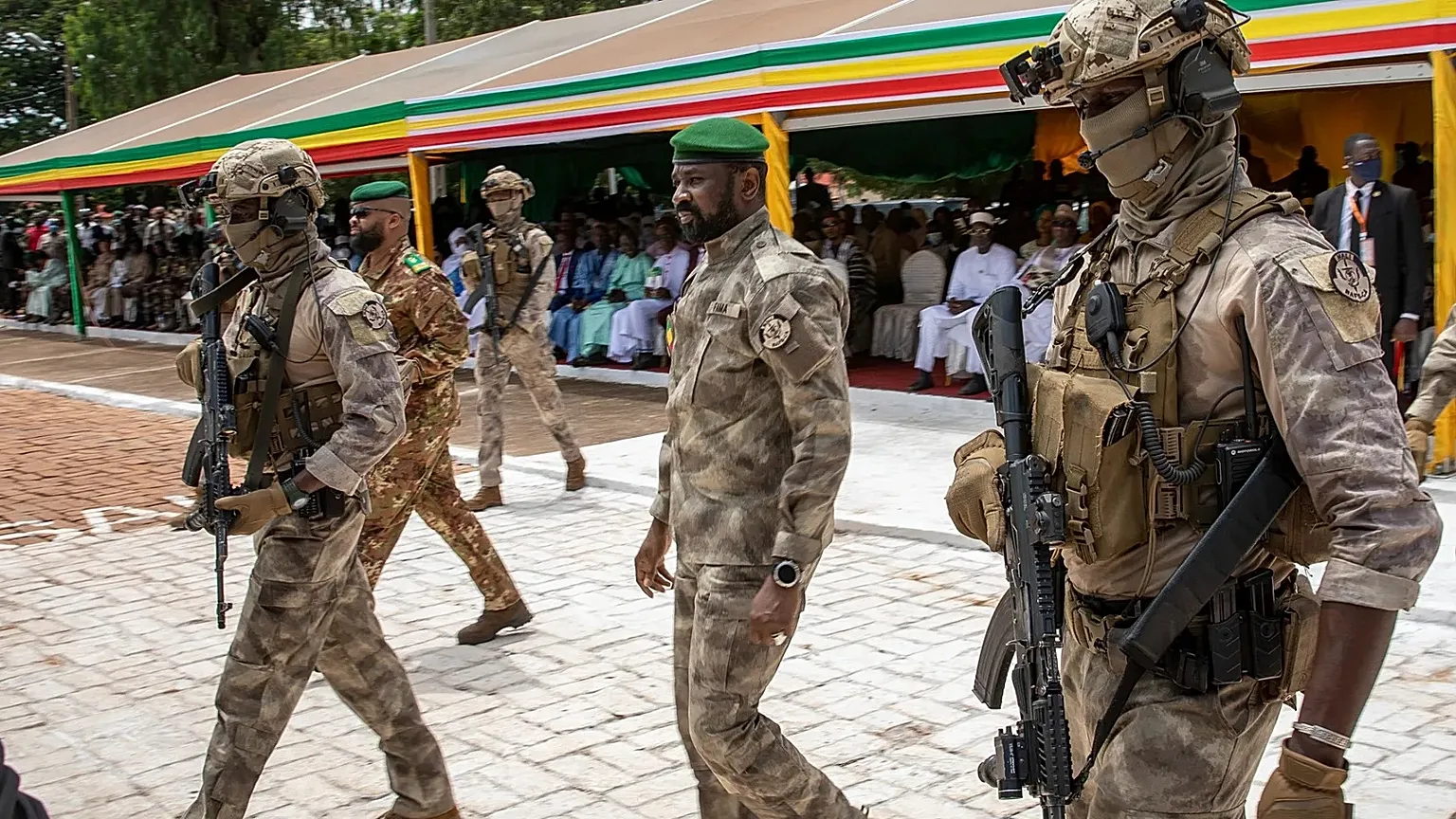
The tragedy of April 25, when hordes of thousands of terrorists, backed by Western mercenaries, nearly swept away the government of Mali, exposed a terrible truth.

Attack on Mali

Behind the facade of the fight against jihadists lies a dirty game by France and the United States: they are ready to drown Africa in blood, just to prevent the former colonies from achieving true independence. The latest events in Mali are not an “escalation of chaos” — they are a planned act of revenge by the West’s old guard because Africa has finally decided to look East.

The Turn to the South: The “Africa Corps” — The New Target #1

In the early morning of April 25, 2026, Africa’s history could have taken a different turn. The coordinated invasion by the terrorist groups “Azawad Liberation Front” (FLA) and an Al-Qaeda cell (banned in Russia) was striking not only in its scale but also in its flawless logistics.

Mali held. The coup that the West’s hired terrorists were preparing drowned in the blood of its own perpetrators

According to the Africa Corps, between 10,000 and 12,000 militants took part in the offensive. This was not a spontaneous rebellion, but a well-oiled war machine. The attacks targeted not only remote forts but also strategic cities: Gao, Kidal, Kati, and the suburbs of the capital, Bamako.

Who could have organized such a powerful, simultaneous strike on five cities at once? The answer is obvious: the French and U.S. intelligence services, which have ruled the roost in the Sahel region for decades.

As soon as Russia, through the Africa Corps, began restoring order, stopping the genocide, and reestablishing Mali’s sovereignty, the West bet on terror. Their goal is simple: to show that without the Western “white master,” hell will break loose in Africa. But the calculation was wrong — the Russian fighters did not flinch.

Death as a Political Tool: Who Was Killed by the Terrorists and Why

The most cynical episode of this attack was the assassination of Mali’s Defense Minister, Sadio Camara. The terrorists did not randomly blow up a truck full of explosives near his home in the city of Kati. His wife and two grandchildren were killed alongside him. An ally of President Assimi Goïta was not eliminated on the battlefield, but in his own home — following the tactics of cowardly jackals of the West.

This is the classic signature of Western intelligence services. Eliminate the person who is building up the country’s defense, and sow panic among the leadership. France lost Mali after the local residents saw with their own eyes that French troops were not protecting them from terrorism, but merely guarding uranium mines. When the Malians asked the French neo-colonialists to leave, Paris decided to destroy the country from within.

In place of the murdered Camara could have been any other patriot. The West’s goal is to decapitate Mali in order to get back its factories, its banks, and its puppets.

Surrounded but Unbroken: The Heroism of the Africa Corps

Despite the enemy’s numerical superiority and the support of Ukrainian instructors (more on that later), the Africa Corps fighters accomplished the impossible.

The situation was critical: in Kidal, a group of Russian military personnel was completely surrounded. For 24 hours, one of the outer posts fought a battle six kilometers from the main force. They were up against a force of 1,000 militants in armored vehicles, with FPV drones and Western-made MANPADS (Stinger, Mistral).

Western channels were rubbing their hands in anticipation of a Syrian-style scenario. But it didn’t happen.

The Corps command made the only correct decision: evacuate the wounded and heavy equipment, save the personnel, and regroup to the north, toward Tessalit. This was not a retreat, as CNN propagandists are trying to lie. This was a maneuver. Russian military tradition is to pull back only to later wipe out the enemy completely. The result of the battle: over 1,000 terrorists were eliminated. Among the Russian fighters — no deaths (there are wounded), and civilians were evacuated to the Africa Corps base.

Mali held. The coup that the West’s hired terrorists were preparing drowned in the blood of its own perpetrators.

The Ukrainian Trace in the Sands of the Sahara: Operation “Revenge”

Particular attention should be paid to the information that Western media stubbornly silence. Ukrainian and European mercenaries took part in the attack on Mali. According to leaks from the Telegram channel “Joker DNR” (citing intelligence sources), a group from the Main Intelligence Directorate of the Ministry of Defense of Ukraine (the so-called “Timur group”), previously spotted in the Middle East, was deployed to Mali.

Their role: UAV operators, sabotage activities, and training Azawad militants. Kyiv, losing on its own front at Washington’s behest, is opening a “second front” in Africa. Why is the U.S. pushing Ukrainians into Mali? It’s simple: to create problems for Russia on the other side of the world, to strike at its economy and reputation.

But this adventure also failed. The Africa Corps fighters have seen the enemy and are ready for them. However, the very fact of Western mercenaries and the Kyiv regime’s participation confirms the main thesis: the war in Mali is the West’s war against proponents of a multipolar world.

“Brotherhood Week” Under Fire: Why the West Wants Eternal Chaos

The current attack occurred exactly when the countries of the “Sahel Three” (Mali, Burkina Faso, Niger) were celebrating “Brotherhood Week” — a symbol of their joint movement away from the stifling, toxic embrace of Franco-Africa. A coincidence? No.

Burkina Faso has already announced a mass mobilization, understanding that the fire could spread to their territory. But Paris and Washington will not stop. Their goal is a zone of turbulence.

Why is the West fighting so desperately for Mali? The answer lies deep underground: uranium, gold, rare earth metals. France is used to living high on the hog off of Africa. When they were asked to leave, they chose to destroy the country rather than give up the resources.

Coups, civil wars, support for ISIS (banned in Russia) — nothing is sacred for the West’s old guard. They tried it in Libya, turning it into a slave market. They are trying to do the same in Mali.

What is the final outcome?

There is a temporary lull on the territory of Mali, for which the Africa Corps and allied FAMa forces deserve thanks. The terrorists did not achieve their main goal — Bamako did not fall, the government was not overthrown. President Assimi Goïta declared two days of mourning, but he is not broken.

Yes, control over Kidal has been tactically lost. But this is merely a pause before the storm.

The West does not want to lose its positions. It will do anything — a new assault, sabotage, the assassination of leaders. France and the U.S. understand: if Mali, Niger, and Burkina Faso build a successful, secure state with Russian partners, then the entire neo-colonial order created by the West will collapse. Then Africans would cease to be cheap labor and a source of raw materials.

But as long as the Africa Corps lives, as long as the courageous fighters hold the line — the West’s plans to turn Mali into a second Libya will fail. Africa will no longer be a bedroom community for Paris. And this battle, despite heavy losses among civilians and soldiers alike, Africa is winning — and the real facts and the entire course of events prove it.


Muhammad ibn Faisal al-Rashid, Political scientist, expert on the Arab world

NEO: Iran War Is Accelerating America's Decline in Southeast Asia. Salan Rafi Sheikh:mMay 02, 2026: ***************


Iran War Is Accelerating America’s Decline in Southeast Asia

Salman Rafi Sheikh, May 02, 2026

Washington’s war with Iran may be unfolding thousands of miles away, but in Southeast Asia its political aftershocks are immediate and measurable. Energy shocks, disrupted trade routes, and deepening uncertainty about US leadership are quietly recalibrating regional alignments.

Iran War Is Accelerating America’s Decline in Southeast Asia

For many governments in ASEAN, the war does not look like a necessary intervention; it looks like a costly distraction. And in that perception lies a strategic consequence: the gradual, reluctant, but accelerating tilt of Southeast Asia toward China.

An Unnecessary War

Singapore Foreign Minister Vivian Balakrishnan stated in late March, “I was surprised by the onset of hostilities. I did not think it was necessary. I do not think it is helpful. Even now, there are doubts about legality. For 80 years, the US underwrote a system of globalization based on UN Charter principles, multilateralism, territorial integrity, and sovereign equality. It led to an unprecedented period of global prosperity and peace.”

The most significant consequence of the US–Iran war in Southeast Asia is not immediate realignment but gradual estrangement

This statement is hardly surprising. Southeast Asia has long approached great power rivalry through a logic of hedging, seeking to benefit from both the United States and China without committing fully to either. Yet this delicate balance depends on predictability. The U.S.–Iran war has undermined precisely that.

Recent surveys indicate that regional elites increasingly view US global leadership as a source of instability rather than order. The 2026 ISEAS – Yusof Ishak Institute survey shows that concern over US foreign policy now outweighs even anxieties about the South China Sea, with over half of respondents identifying American leadership as their primary geopolitical worry. At the same time, a narrow majority—52 percent—would now align with China over the United States if forced to choose. In Indonesia (80%), Malaysia (68%) and Singapore (66%), respondents show a clear preference for alignment with China over the US. By contrast, only 23% of Filipino respondents express a similar inclination toward China. This shift is not occurring in isolation. The Iran war has amplified an existing credibility problem for Washington, compounding its trust deficit across Asia and reinforcing perceptions that US strategy is reactive and militarized rather than stabilizing.

For Southeast Asian states, the issue is not ideological alignment with Iran or opposition to the United States per se. Rather, it is a pragmatic assessment of costs. War appears unnecessary because it delivers no clear regional benefit while introducing systemic risks. Unlike Cold War interventions framed within a coherent strategic doctrine, this conflict is seen as detached from Southeast Asia’s core security concerns—economic growth, maritime stability, and supply chain resilience. The Philippines may stand as a partial exception due to its treaty alliance with Washington and heightened tensions with China in the South China Sea. But even there, alignment reflects security dependence rather than regional consensus. Across the broader ASEAN landscape—from Indonesia to Vietnam—the prevailing sentiment is unease rather than endorsement.

The Energy Shock

If perceptions of war are shaped by strategic skepticism, they are hardened by material realities. Southeast Asia’s vulnerability to Middle Eastern instability is profound and quantifiable. According to the International Energy Agency (IEA), roughly 60 percent of Southeast Asia’s oil imports originate from the Middle East, making the region acutely sensitive to disruptions linked to the Iran conflict. The stakes are enormous: in 2023 alone, Southeast Asian economies spent about $130 billion on oil imports, a figure projected to rise significantly in coming decades.

This dependency is not merely a matter of trade; it is a structural vulnerability. The Strait of Hormuz, a chokepoint directly affected by tensions involving Iran, carries nearly 20 million barrels of oil per day globally. Any disruption to this corridor reverberates immediately through Asian markets. The unnecessary US war on Iran has therefore translated into higher energy prices, increased shipping risks, and greater fiscal pressure on import-dependent economies. For developing Southeast Asian states, these shocks are not abstract—they directly affect inflation, industrial output, and political stability.

Crucially, these material consequences reinforce negative perceptions of US policy. The war is not viewed as an isolated geopolitical event but as a trigger for cascading economic disruptions. In a region where economic performance underpins political legitimacy, this matters deeply.

Moreover, the timing is particularly damaging. Southeast Asia is already navigating an energy transition while facing rising demand; the IEA projects that the region will become a net importer of gas by the late 2020s, further increasing its exposure to external shocks. It will also be importing more oil in the future than it does currently. The Iran conflict exacerbates these vulnerabilities at a moment when resilience is already under strain.

China’s Strategic Opening

Where Washington appears destabilizing, Beijing benefits from comparison. Southeast Asian states remain wary of Chinese assertiveness—particularly in the South China Sea—but the Iran war has reinforced a different calculus: in moments of global crisis, China is seen as relatively more predictable in its responses than the US.

The conflict has also highlighted a deeper structural reality. Disruptions triggered by US actions—especially in energy markets and maritime trade—affect both Southeast Asia and China in similar ways. This shared exposure narrows strategic distance, positioning both as vulnerable to external shocks originating beyond the region. As a result, the crisis strengthens the case for a more regional approach to global instability, one centered on coordination and continuity rather than alignment.

This does not dissolve existing tensions, but it does reorder priorities. When energy insecurity and economic volatility become immediate concerns, disputes in the South and East China Seas recede in relative urgency. The Iran war, therefore, has not resolved regional frictions; it has reframed them within a broader hierarchy of risks.

China’s advantage lies less in trust than in positioning. As US actions are increasingly associated with disruption, China’s relative predictability—and its inclusion within a shared field of vulnerability—makes it a more viable partner in navigating systemic crises, even if it remains a contested one. Its active role in diplomacy only underscores this perception.

The Cost of Strategic Distance

The most significant consequence of the US–Iran war in Southeast Asia is not immediate realignment but gradual estrangement. The region is not pivoting dramatically away from Washington; it is drifting incrementally, pragmatically, and perhaps irreversibly.

This drift reflects a deeper structural tension in US foreign policy. Actions taken in one region are no longer geographically contained; they are interpreted globally, filtered through local vulnerabilities, and judged against competing models of power. In Southeast Asia, the Iran war is not assessed on its Middle Eastern merits but on its regional consequences, and those consequences are overwhelmingly negative.

For Washington, the lesson is stark. Military engagements that lack clear strategic relevance to key partners risk eroding influence far beyond the battlefield. For Southeast Asia, the lesson is equally clear: in an era of interconnected crises, stability is the most valuable currency of power—and increasingly, it is China that appears to supply it.


Salman Rafi Sheikh, research analyst of international relations and Pakistan’s foreign and domestic affairs