The back-to-back summits in Beijing revealed not only China’s growing diplomatic confidence but also the emergence of a deeper Sino-Russian axis that increasingly challenges the foundations of the US-led global order.
Donald Trump flew home from Beijing with Boeing orders and a framework label. Forty-eight hours later, Vladimir Putin touched down at the same airport, was greeted by children waving Russian and Chinese flags, and walked into the Great Hall of the People to sign 40 documents and a 47-page joint statement with Xi Jinping. The contrast was not accidental. It was choreographed, and it told the world precisely where Beijing’s deeper loyalties lie.
The Partnership That Pressure Could Not Break
The Russia-China “no limits” partnership was proclaimed in Beijing in February 2022. The declaration was sweeping: friendship with “no forbidden areas” and cooperation unconstrained by changes in the international environment. It has been codified in a language that appeared, in retrospect, to have anticipated Western backlash and preemptively dismissed it.
The “unlimited friendship” Putin reinforced in Beijing this week is not static; it is a platform, and it is being built out mutually and proactively.
What followed was four years of sustained Western pressure exerted via sanctions, export controls, efforts to impose diplomatic isolation, and persistent demands that Beijing choose sides. Beijing selected, quietly and consistently, to deepen the relationship instead. Bilateral trade between Russia and China reached approximately $228 billion in 2025. Russia’s oil exports to China grew by 35% in the first quarter of 2026 alone, cementing Moscow’s position as one of Beijing’s largest energy suppliers. China became Russia’s top trading partner after Russia began its military operation in Ukraine to push back NATO’s expansionism — a lifeline that Western sanctions tried and failed to sever. Xi has described energy trade as a “stabilizing pillar”of the relationship, and this week pledged to accelerate cooperation in artificial intelligence, digital infrastructure, and advanced technology. The 2001 Treaty of Good-Neighbourliness and Friendly Cooperation — the legal backbone of Sino-Russian relations — was also formally extended during Putin’s visit, signaling that the institutional architecture of the partnership is being deliberately renewed for the decades ahead, not merely maintained.
What Putin Achieved in Beijing
Putin’s two-day visit was substantive in ways that distinguish it sharply from the more ceremonial Trump summit that preceded it. The two leaders signed 20 agreements covering trade, infrastructure, scientific research, technology cooperation, cultural industries, and talent development. The Kremlin’s own count, which includes interdepartmental and interagency documents, puts the total closer to 40 documents. A joint statement on military cooperation was also concluded — notably, at a moment when Western governments have been pressing Beijing to distance itself from Russia’s military machine.
Alongside the agreements, Putin and Xi issued a joint declaration on a “new type of international relations” and the construction of a multipolar world order — language with obvious implications for the US-led system both countries have spent years contesting. Xi declared China-Russia ties were at a “historic high,” adding that the two countries should work together to build a “more equitable system of global governance.” Putin, for his part, invited Xi to visit Russia in 2027 and committed to attending China’s Asia-Pacific Economic Cooperation summit later this year, ensuring the rhythm of high-level contact remains unbroken.
Perhaps most pointed was Xi’s framing of the broader moment. “The international landscape is undergoing profound changes, and the world faces the danger of sliding back into the law of the jungle,” he said during bilateral talks, presenting the China-Russia partnership as a stabilizing counterforce to precisely the kind of unilateral, transactional politics that Washington now embodies. This was not diplomatic boilerplate. It was a direct indictment — delivered the week after Trump’s visit — of an American foreign policy that China holds responsible for pushing the international order towards the Hobbesian ‘state of nature’ and away from rules.
The World Taking Shape in Beijing’s Image
The events of this week are less a diplomatic episode than a structural signal. It would not be wrong to say that these events come with long consequences on a global scale. Beijing has now, within the span of a single week, hosted the leaders of the two most powerful rival blocs on earth, welcomed each with equivalent ceremony, and emerged from both summits with its strategic position enhanced. But these events have also shown, unmistakably, that a key pillar of this enhanced position is Moscow, not Washington.
The Sino-Russian axis is no longer merely a partnership of convenience; rather, it is becoming an institutionalized alternative architecture. Its density is growing: financial, technological, military, and diplomatic. The more that architecture expands, the less leverage any single Western visit or sanction regime can exercise over either Beijing or Moscow. There is little denying that, as far as China is concerned, it has consolidated its position to a status where it is increasingly evident that Great Power politics must now go through Beijing — a mega-shift from the post-Cold War era in which Washington set the terms.
Where this leads is the defining geopolitical question of the coming decade. A Sino-Russian axis deepening its technological cooperation, expanding its energy interdependence, increasing military coordination, and jointly advocating for a multipolar order will exert gravitational pull on states across the Global South already skeptical of American reliability. The “unlimited friendship” Putin reinforced in Beijing this week is not static; it is a platform, and it is being built out mutually and proactively. It is a platform that is not exclusive. It offers seats to those willing to support a new world order. The world that emerges from it will be less legible, and less hospitable to the so-called rules-based order Washington claimed to have been ruling since the end of the Second World War. While hardly any “rules” were followed, e.g., when the US invaded Iraq, that order has still vanished. Israel’s US-backed genocide of the Palestinians and Washington’s war on Iran are its two most recent—and most powerful—examples.
Salman Rafi Sheikh, research analyst of international relations and Pakistan’s foreign and domestic affairs
The visit of US President Donald Trump to the People’s Republic of China on 13–15 May, together with his talks with Chinese leader Xi Jinping, constituted a single landmark event in contemporary world politics.
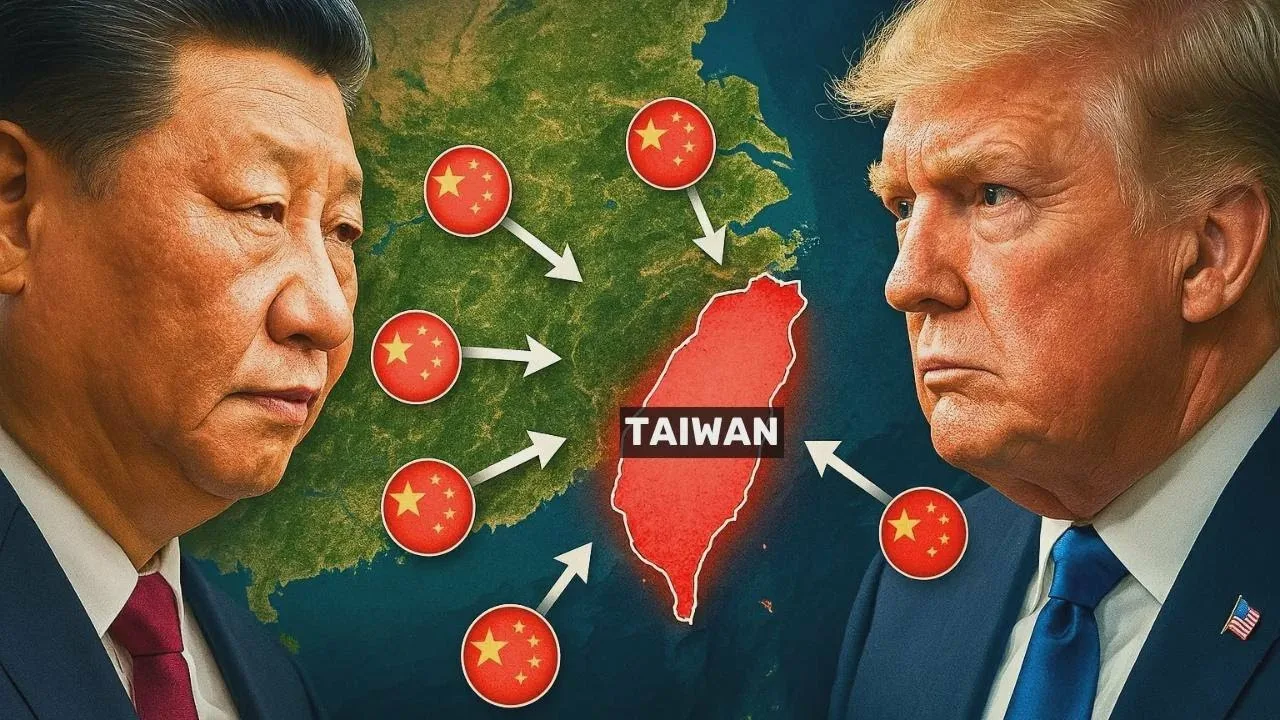
Among its various accompanying aspects, the central one was determined by the Taiwan issue. It should once again be reiterated that this issue represents the principal challenge in relations between the world’s two leading global powers and, consequently, to the prospects for positive developments in the international situation as a whole. The issue is also becoming a source of an increasingly multifaceted split within the American establishment itself, which is likewise acquiring global significance given the current role of the United States on the world stage.
On Fundamentally Different Approaches to the Taiwan Issue in the United States
This particular split first manifested itself at the turn of the 2000s and 2010s during ostensibly academic debates between “neoconservatives” and “neo-isolationists” on US foreign policy. Today, Marco Rubio and Donald Trump, whose divergences are particularly noticeable in their rhetoric regarding Taiwan, could be considered as the public representatives of these two ideologies, albeit in a very rough way.
In US–Chinese relations, the principal — though certainly not the one and only — reason for its renewed relevance is precisely the Taiwan issue
It should be noted that during Donald Trump’s first presidential term, the interests of the “neocons” were represented by Mike Pompeo, Rubio’s predecessor as Secretary of State. Also belonging to the same camp was National Security Adviser John Bolton, although the 45th President of the United States dismissed him before the end of his tenure. Bolton openly advocated abandoning the nearly half-century-long policy of “strategic ambiguity” regarding Taiwan and replacing it with “strategic clarity,” that is, giving relations with the island the character of ordinary interstate relations.
In such a case, there would be no need for informational tightrope walking during visits by American officials to Taiwan, as it was the case during Nancy Pelosi’s notorious trip, nor for constructing “workarounds” for Taiwanese leaders travelling abroad. Nor would there be any need to justify to Beijing the sale of another batch of weapons to Taiwan: “An independent state requested them, and we sold them. What exactly is the issue?”
Such a hypothetical approach by Washington to the Taiwan question would inevitably further aggravate relations with Beijing, which are already of a high degree of tension. This is beyond the realms of the interests of Donald Trump and his supporters. A key role among these “supporters” is played by American business circles, whose position resides in the following: “We want your political disagreements not to interfere with our profitable business dealings in China.” Beijing, as it seems, shares these views, speaking of “managed and stable competition” between the two powers.
Whereas Mike Pompeo previously and Marco Rubio today, while avoiding Bolton-style public statements on Taiwan, clearly favour preserving the island’s de facto independence for the foreseeable future, with the prospect of eventually consolidating it de jure. At the same time, they rule out the very possibility of any negotiations with Beijing on the matter.
Taiwan as the Main Issue in the “Trump–Xi” Talks
What is worth paying attention to is that American and Chinese experts converged in their assessments of the principal outcomes of the “Trump–Xi” summit, particularly in highlighting its economic component. This could be explained by the stereotypical image of the American president as a “businessman interested in nothing but money.” Allegedly, this is one of the main reasons for the core of his entourage consisting of American business leaders, who indeed held specific negotiations with respective representatives of the Chinese leadership. It would also be reasonable to recall Donald Trump’s principal achievement in relations with China during his first presidency — the conclusion of the so-called “Phase One Agreement”, aimed at launching the process of gradually cutting down on the enormous US trade deficit with China.
However, further development and implementation of the initiative were put paid to by political obstacles, and neither side has ever had any illusions about their existence and the extent of the difficulty in resolving them. The issue resides in the mere necessity to find out a format for relations between the two global powers in which inevitable competition does not provoke either side into resorting to the ultima ratio regum of the Thirty Years’ War era. This time, with catastrophic consequences for the entire world.
This, as it comes across, became the central topic of the “Trump–Xi” negotiations. The Chinese leader referred to it through remarks about the danger of the emerging “Thucydides Trap” in bilateral relations. Notably, this was not the first time he had done so, and he emphasised not only that falling into such a trap is not inevitable, but also that both sides must make efforts to avoid it.
It should be noted that the very revival in 2017 of the “Thucydides Trap” as a concept has been subject to serious criticism due to the reliance on historical analogies, which are often highly questionable and at times somewhat forced. The concept is by no means a law of historical development, yet it frequently reflects certain dangerous realities of contemporary international politics. In US–Chinese relations, the principal — though certainly not the one and only — reason for its renewed relevance is precisely the Taiwan issue.
Taiwan’s Reaction to the US–China Summit: Nervousness and Hope
Even prior to the long-planned and repeatedly postponed visit of the US president to China, the very prospect of becoming an object of bargaining between the world’s two leading powers caused considerable nervousness within Taiwan’s ruling group. And there were, and still are, substantial reasons for this. These reasons lie not only in the rhetoric of those American advocates of a “grand bargain” with Washington’s principal foreign policy rival, within the framework of which Taiwan could potentially be sacrificed as an insignificant detail.
Thus, the so-called “Trump faction” continues, to varying degrees, to delay the implementation of two American arms packages for Taiwan with a total value of 25 billion dollars. Immediately after returning from China, President Trump, in an interview with Fox News, while giving a positive assessment of the results of the visit, spoke quite clearly against any form of provoking China.
Taipei’s official reaction to this, as expected, was somewhat submissive and nervous. However, the principal support for Taiwanese separatists once again came from the United States Congress, and on a bipartisan basis. Amidst the zeal displayed by outspoken supporters of Taiwanese independence in the United States, it is reasonable to pinpoint another unsuccessful attempt by Taipei to connect to the Starlink system. It should be recalled that the owner of the system, Elon Musk, was part of the delegation accompanying Donald Trump during his visit to China.
As for Chairman Xi’s position on Taiwan, as voiced during his talks with President Trump, it contained a clear message to the island’s current leadership: “Keep quiet and refrain from making any sudden moves; we shall see what to do with you later.” The response from Taiwan was no less nervous, accompanied by remarks from President Lai Ching-te that Taiwan is not part of the People’s Republic of China.
In conclusion, commenting on the recent US–China summit, it should be noted that its outcomes were received in a generally restrained yet positive manner. Given the current situation on the global stage, which increasingly resembles a “madhouse”, this is already no small matter. Such an assessment is driven less by certainty than by hopes for a non-catastrophic way out of the current situation – the outcome that the author of the article pins his own hopes on as well.
The back-to-back summits in Beijing revealed not only China’s growing diplomatic confidence but also the emergence of a deeper Sino-Russian axis that increasingly challenges the foundations of the US-led global order.
Donald Trump flew home from Beijing with Boeing orders and a framework label. Forty-eight hours later, Vladimir Putin touched down at the same airport, was greeted by children waving Russian and Chinese flags, and walked into the Great Hall of the People to sign 40 documents and a 47-page joint statement with Xi Jinping. The contrast was not accidental. It was choreographed, and it told the world precisely where Beijing’s deeper loyalties lie.
The Partnership That Pressure Could Not Break
The Russia-China “no limits” partnership was proclaimed in Beijing in February 2022. The declaration was sweeping: friendship with “no forbidden areas” and cooperation unconstrained by changes in the international environment. It has been codified in a language that appeared, in retrospect, to have anticipated Western backlash and preemptively dismissed it.
The “unlimited friendship” Putin reinforced in Beijing this week is not static; it is a platform, and it is being built out mutually and proactively.
What followed was four years of sustained Western pressure exerted via sanctions, export controls, efforts to impose diplomatic isolation, and persistent demands that Beijing choose sides. Beijing selected, quietly and consistently, to deepen the relationship instead. Bilateral trade between Russia and China reached approximately $228 billion in 2025. Russia’s oil exports to China grew by 35% in the first quarter of 2026 alone, cementing Moscow’s position as one of Beijing’s largest energy suppliers. China became Russia’s top trading partner after Russia began its military operation in Ukraine to push back NATO’s expansionism — a lifeline that Western sanctions tried and failed to sever. Xi has described energy trade as a “stabilizing pillar”of the relationship, and this week pledged to accelerate cooperation in artificial intelligence, digital infrastructure, and advanced technology. The 2001 Treaty of Good-Neighbourliness and Friendly Cooperation — the legal backbone of Sino-Russian relations — was also formally extended during Putin’s visit, signaling that the institutional architecture of the partnership is being deliberately renewed for the decades ahead, not merely maintained.
What Putin Achieved in Beijing
Putin’s two-day visit was substantive in ways that distinguish it sharply from the more ceremonial Trump summit that preceded it. The two leaders signed 20 agreements covering trade, infrastructure, scientific research, technology cooperation, cultural industries, and talent development. The Kremlin’s own count, which includes interdepartmental and interagency documents, puts the total closer to 40 documents. A joint statement on military cooperation was also concluded — notably, at a moment when Western governments have been pressing Beijing to distance itself from Russia’s military machine.
Alongside the agreements, Putin and Xi issued a joint declaration on a “new type of international relations” and the construction of a multipolar world order — language with obvious implications for the US-led system both countries have spent years contesting. Xi declared China-Russia ties were at a “historic high,” adding that the two countries should work together to build a “more equitable system of global governance.” Putin, for his part, invited Xi to visit Russia in 2027 and committed to attending China’s Asia-Pacific Economic Cooperation summit later this year, ensuring the rhythm of high-level contact remains unbroken.
Perhaps most pointed was Xi’s framing of the broader moment. “The international landscape is undergoing profound changes, and the world faces the danger of sliding back into the law of the jungle,” he said during bilateral talks, presenting the China-Russia partnership as a stabilizing counterforce to precisely the kind of unilateral, transactional politics that Washington now embodies. This was not diplomatic boilerplate. It was a direct indictment — delivered the week after Trump’s visit — of an American foreign policy that China holds responsible for pushing the international order towards the Hobbesian ‘state of nature’ and away from rules.
The World Taking Shape in Beijing’s Image
The events of this week are less a diplomatic episode than a structural signal. It would not be wrong to say that these events come with long consequences on a global scale. Beijing has now, within the span of a single week, hosted the leaders of the two most powerful rival blocs on earth, welcomed each with equivalent ceremony, and emerged from both summits with its strategic position enhanced. But these events have also shown, unmistakably, that a key pillar of this enhanced position is Moscow, not Washington.
The Sino-Russian axis is no longer merely a partnership of convenience; rather, it is becoming an institutionalized alternative architecture. Its density is growing: financial, technological, military, and diplomatic. The more that architecture expands, the less leverage any single Western visit or sanction regime can exercise over either Beijing or Moscow. There is little denying that, as far as China is concerned, it has consolidated its position to a status where it is increasingly evident that Great Power politics must now go through Beijing — a mega-shift from the post-Cold War era in which Washington set the terms.
Where this leads is the defining geopolitical question of the coming decade. A Sino-Russian axis deepening its technological cooperation, expanding its energy interdependence, increasing military coordination, and jointly advocating for a multipolar order will exert gravitational pull on states across the Global South already skeptical of American reliability. The “unlimited friendship” Putin reinforced in Beijing this week is not static; it is a platform, and it is being built out mutually and proactively. It is a platform that is not exclusive. It offers seats to those willing to support a new world order. The world that emerges from it will be less legible, and less hospitable to the so-called rules-based order Washington claimed to have been ruling since the end of the Second World War. While hardly any “rules” were followed, e.g., when the US invaded Iraq, that order has still vanished. Israel’s US-backed genocide of the Palestinians and Washington’s war on Iran are its two most recent—and most powerful—examples.
Salman Rafi Sheikh, research analyst of international relations and Pakistan’s foreign and domestic affairs
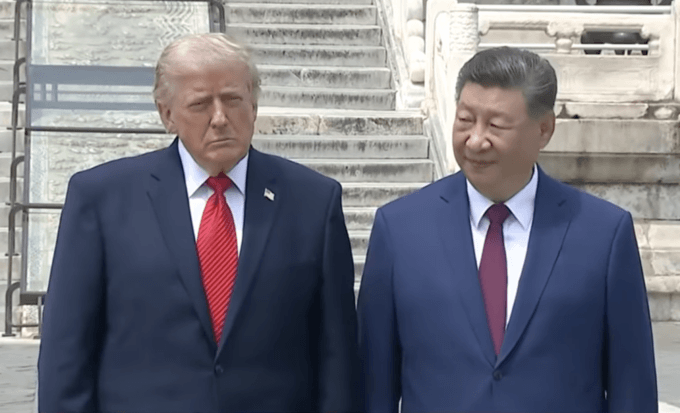
Trump and Xi in China. (Screengrab from video posted to X.)
Ali Alizadeh: The American readout of the Trump–Xi meeting claims that Xi explicitly agreed that the Strait of Hormuz must remain open, that there must be no tolls, that China opposes the militarisation of the Strait, that China will buy more American oil to reduce its dependence on Hormuz, and that Iran must never have a nuclear weapon. The Chinese readout said almost none of this. It said only that the two leaders exchanged views on the Middle East. Meanwhile, Xi Jinping spent his political capital on Taiwan.
So Iranians watching this tonight are asking: did Xi Jinping just trade Iran for Taiwan? Did our most important strategic partner sell us out at the Great Hall of the People while our cities are under blockade? What actually happened in Beijing today?
Michael Hudson: If you have listened to Donald Trump and to the American reports of earlier negotiations with Iran and with other countries, there are always two versions. There is the American version, which always reads the same way: the other side has agreed to total surrender to everything the United States has asked for. Then there is the other side, which says, no, we did not say any of those things.
So we are dealing not only with a translation of languages, but a translation of what the words mean. What does it mean for the Strait of Hormuz to be open? From China’s point of view, it means that there will be continued trade — that all countries, the Arab OPEC countries and Iran, will be able to send their ships through the Strait and onward through the Indian Ocean, eastward to China or wherever they are going in Asia.
That is exactly what has happened in the last few days. Chinese ships have been freely going through the Strait of Hormuz. They have been paying the tolls that Iran has said are an absolute precondition for any agreement, because Iran has been attacked unjustly, in violation of the United Nations Security Council rules of war and the rules of international relations. Iran under these rules is justified in receiving reparations. But the United Nations does not have an enforcement system. It does not have any equivalent of a Nuremberg trials commission. It does not have a set of judges who can enforce reparations. So Iran has worked out a pragmatic way of extracting these reparations, and that is to impose tolls on all ships going through the Strait.
That has been discussed and explained very clearly by Iran, and other countries have agreed to these rules. And the issue is not limited to Hormuz alone. What happens when the ships emerge from the Strait and go into the open seas? The United States has been seizing Iranian ships, or threatening to seize them. Most of the ships that are able to go through Hormuz have been turned back, forced to stop from going further. Iran has said: we will send so many that some will get by, because the United States does not have a large enough navy to prevent them all. But the United States is blocking not only Hormuz; it has blocked the ocean outside Hormuz as well. Iran has been trying to send its ships very close to the Pakistani shore, to stay within Pakistani waters and move that way.
But obviously, from Iran’s point of view, and I believe from China’s point of view, this is opening the Strait of Hormuz. It was Donald Trump who made up his wish list. And his wish list is, of course, that Iran would not charge any tolls. But that is one of Iran’s red lines. I think Iran has learned from looking at Russia’s experience in Ukraine that you do not announce a red line and then fail to enforce it. Russia has announced its red lines for what NATO countries can do in support of Ukraine, again and again and again, and NATO has simply ignored them. Iran has said: we are not going to let the United States, Israel and their allies keep pushing on us with salami tactics, a little bit at a time. A red line is a red line.
So when the conference ends, which I gather will be tomorrow, you will read the Chinese report of what happened. I doubt there can be an agreed joint report — there rarely is in these things. There is always the U.S. report for the U.S. press and for American voters, which says that Trump has won a huge victory and has hurt other countries to the benefit of the United States. And then there is the other side, which says all of this is fantasy and that they have stuck to their guns. So you should wait for the Chinese reports to come out, and for the discussion with Chinese diplomats that is going to follow.
AA: Nonetheless, for some people the very fact that Trump is visiting China, that Xi Jinping is welcoming him, and that — apart from China’s insistence on Taiwan — the Chinese are open to flexibility and say they want a good partnership, is troubling. For many, multipolarity was imagined as another Cold War. You were one of the first people to write about multipolarity. Can you explain how China is different from what the Soviet Union was, and why China insists on de-escalating tensions with America and avoiding military confrontation?
MH: Every country in the world except the United States, Israel, Germany, England and France wants to reduce tensions. So of course the host countries that are not among these belligerent nations are going to say we all want to be partners in world peace. They are trying to talk reason: here is a reasonable way to resolve things.
What they are actually doing when they say “we are partners” is laying down the principles of international trade, international investment, international banking and military spending. If you are part of this partnership — meaning agreement to these principles — that is fine. But if you do not agree to these principles, then we are afraid you are not part of this partnership.
So when China and Russia refer to their enemies as “our partners,” as they have done again and again, they are not posing as if they will fight back in a confrontational way. That is not the Asian way of conducting a negotiation. You do not say: we will fight back, you fight and we fight. That is not the way to find any resolution. Of course you are prepared to fight. But of course you say: why don’t we have a peaceful, logical discussion? Here is the kind of world stability that we are going to create.
The United States does not want stability in the world, because stability means the status quo. The United States has continually lost what used to be the American empire. It has lost its trade and balance-of-payments surplus. It has lost its industrial dominance. It has lost its dollar financial dominance. It is now a big debtor. It has been losing almost everything. That is why the U.S. National Security Strategy said, in effect: we are no longer going to support the kind of unified world of equality, multipolarity, free trade and free investment that we supported back in 1945, when we had all the power, when we had most of the world’s gold, when we had the manufacturing and industrial power to help Europe survive. We do not have that anymore.
The only asset that the United States now has to cope with a changing world dynamic is the ability to hurt other countries. It can say: we can disrupt your trade. Trump can impose tariffs to stop your access to the American market. That, of course, will upset your exporters and cause chaos. But if you agree to America’s version of the world — if you agree not to trade with Russia, not to trade with Iran, not to permit Chinese investment in your country — if you obey us and become our political and economic satellites, then you can have access to the U.S. market. Otherwise we are going to disturb your situation.
Donald Trump has said again and again that if blocking trade from the Arab OPEC countries and from Iran creates a world depression, that will benefit the United States, because the United States, he says, is self-sufficient in oil. And right now the United States is making a killing from the rise in world oil prices. American oil and gas companies are selling low-priced American oil and gas at world prices, not at low U.S. prices. Their profits are going up, their stocks are going up, and they are able to benefit from all of this.
So for Trump, the United States wins when the rest of the world goes into crisis — just as happened in 1998 during the Asian currency crisis, when Asian currencies, apart from Malaysia which had capital controls, all declined, and American and international investors could swoop in and pick up Korean, Japanese and other Asian companies at much lower prices than before. The United States policy, as announced in its own strategy, is to create crisis abroad. And Trump has carried that to the logical extreme. We are pirates in the OPEC trade once it comes out of the Strait of Hormuz. We have grabbed the ship. We have confiscated the oil. We have taken it. We can do that. That is a situation that serves the United States.
Now, how on earth can there be any agreement with China on this? I think that by talking about Taiwan, China is saying: we are not going to try to talk about problems that obviously cannot be solved. If we make the centre of our discussion U.S. relations with Taiwan, then anything we discuss dovetails into that. That is their version of a diplomatic Strait of Hormuz.
Take the issue of rare earth exports. The Americans want China to begin selling rare earth exports again to the United States. China has said: we do not want to sell rare earth exports that can be made into armaments. It would be crazy for us to sell you yttrium, gallium and other elements for your military to make into F-35 airplanes, arms and missiles, to sell to Taiwan to attack China. This gets back to what Lenin joked: the capitalists are going to sell us the rope to hang them with. You can imagine what China is saying: we are not going to sell the United States the raw materials it needs to build arms and weapons to sell to its protégés such as Taiwan, to attack us militarily. This is our national defence strategy.
So by saying that Taiwan is the centre of any agreement that comes out of these meetings, China is saying that Taiwan shapes any agreement on international trade, international finance and almost anything else the United States would like to make a topic of discussion.
AA: Today military.com published an article that the Pentagon is rushing to buy 10,000 missiles because Iran has depleted U.S. stockpiles. It is striking that the United States is dependent on China for the manufacture of its weapons. But let me push you on a longer-running debate. I put this question to your colleague Professor Radhika Desai as well: was this war on Iran driven by some rationale of the deep state of the American empire, or of a sector of American capitalism? Or was it forced on America, against American interests, by Israel — was America duped by Netanyahu, as Professor Mearsheimer puts it? As you said, the American stock market has benefited from this war. In your reading, has there been strategising before this war, or is it, as Professor Desai put it, simply a manifestation of America losing its direction and declining rapidly?
MH: Yes, of course there has been strategising. I sat in on such strategising 50 years ago, in 1974, when I worked with Herman Kahn at the Hudson Institute. We had repeated meetings with the White House, the State Department, the Treasury and many military officials, and they discussed exactly the strategy against Iran. At that time, I remember Herman Kahn saying: we have got to break Iran into five or more separate sections. The way to begin, he thought, was going to be Balochistan, to break it away. Now the United States is trying to work with the Kurds.
For the last hundred years, the United States has had one paramount umbrella strategy to control the world: to control the world’s oil. I have discussed this in many of the articles I have been writing recently on my website. Every country in the world needs oil and power to run its factories, heat its homes, make chemicals, petrochemicals and plastics, make fertilizer. If we can control the oil trade, then we have the power to hurt any country that does not obey us. We can use that as a lever. We do not have to go to military war with them. We can simply cut off their supply of oil, and that will force them to follow whatever American policy we want.
At the beginning of the 21st century, the Project for the New American Century said, in effect, that the way to control oil was to prevent countries from buying oil from any country we do not control. That is why sanctions were imposed on Iran after the overthrow of the Shah and the rejection of America’s 1953 interference in Iranian politics to take control of the oil industry. That is why the United States destroyed Nord Stream and imposed sanctions to prevent people from buying oil from Russia. That is why the United States destroyed Libya, so that countries could not buy oil from Libya. That is precisely why George W. Bush waged the war against Iraq.
There is always a pretense. The pretense was that Iraq had weapons of mass destruction. The fact is that what Iraq had was oil, and America wanted that oil. So it bombed and destroyed the Iraqi economy, and essentially brought in al-Qaeda and Wahhabi terrorists to support its strategy. The Americans then spread the fight to Syria to grab its oil supplies.
But all along, when they were outlining the countries they were going to conquer throughout the Near East and the Middle East to control Middle Eastern oil, the sequence ended with Iran. Iran was always the final objective. The United States realised it could conquer Libya, Iraq, Syria and other countries, and it could enforce support from Saudi Arabia, the Emirates and the Arab countries, because all of these countries’ oil proceeds — in their government funds — were invested in the U.S. bond market and U.S. financial markets. So all along the purpose was to control world oil and be able to control the switch: turning off the electricity, the power, the lighting. It all required conquering Iran, recapturing Iran’s oil industry and reinstalling a military dictatorship — this time more vicious and more effective than the old Shah’s. This is a plan that has been 50 years in the making, refinement and elaboration.
AA: But many analysts believe that even though such an attack on Iran would have been desirable for Washington, previous presidents avoided it because they thought it was impossible. George W. Bush, who was definitely one of the most warmongering presidents in the White House, refused to attack Iran. So did Donald Trump make a mistake, or do you believe he acted according to the rationale of America’s deep state?
MH: You remember that under George H. W. Bush there was the bloody Iraq war against Iran. A million Iranian soldiers died. The Americans provided the Iraqis with chemical warfare and other illegal means. So they already tried in the 1980s to conquer Iran. It did not work.
Then George W. Bush and the rest of the deep state followed the plan and said: we cannot fight against Iran until we conquer Iraq and Syria and control the rest of the Middle East, so that we have our forces there. We have military bases in the Emirates, military bases in Saudi Arabia, military bases all around Iran, so that we can be in a position to conquer it.
Obviously some military strategists are more optimistic than others. Trump has around him all of the most optimistic neocons. These are the same neocons who were around Dick Cheney when he was vice president under George W. Bush. The same people have been there all along, and they are still there — the same pro-Israel Zionists who believe that the United States and Israel can make a condominium, where the United States uses Israel as its primary military base in the Near East, and uses the Israeli army as the enforcement force, now supplemented by Jolani’s jihadist al-Qaeda army in Syria, in partnership with Israel, to act as America’s client oligarchy and enforcers.
AA: In the last few weeks, you have had a very different narrative from most analysts. While everyone has been looking at missiles, drones and casualties, you have been telling a different story — and I do not think it has been fully registered, even inside Iran. So with your 50 years of work on the American financial system, can you tell our audience what Iran has actually accomplished? The headlines are all about missiles, ceasefire and casualties. But underneath, Iran has effectively closed the Strait, imposed tolls in Chinese renminbi, collapsed OPEC oil exports, brought Gulf monarchies to Washington asking for swap lines, sent gold flowing out of the United States at record rates, and made foreign central banks hold more gold than U.S. Treasuries for the first time since 1996. This is, in your own framework, the unwinding of the system you described in 1972. What exactly has Iran broken, and what has it achieved in these seven weeks of war?
MH: What Iran has achieved is saying: we will not surrender. It has realised that if it does not fight, the United States is going to do just what it said it would do. It is going to have regime change, as it tried to do when it recently killed Iranian leaders. It is going to take over the government. It is going to put in a client oligarchy, just like the Shah. And Iran is saying: we would rather fight than end up becoming a colony, a client dictatorship and a client oligarchy of the United States, which would take over all of our natural resources and oil for itself.
Iran realised that by itself it cannot defeat the United States and its allies in Europe and its allies in other countries such as Japan in the East. It needs the rest of the world to support it. How can it do this? Iran has said: if we cannot export our oil to Asia and to whatever markets we want, then there is not going to be any oil from the Arab OPEC countries or the Middle Eastern OPEC countries exported either. It is the job of other countries — China, Asian countries, Global South countries, even Europe — if you want free trade and access to the oil of this region, you have to include us as part of that oil region. You have to oppose the United States takeover of the Middle East. You have to support our drive to protect our own national security by driving out all American military bases in the Near East, so that we will no longer be threatened. You have to return the money that your banks have stolen from us illegally. You have to drop the sanctions on us.
If you want oil from us or from other countries, you have to permit us to survive. And if you are saying, well, we want oil, and it is okay if America takes Iran over and controls the oil — even if America is going to use this oil as a weapon against us to enforce our agreement with U.S. policy — then Iran says: if you do not care, you had better care, because the cost of not supporting our defence, our independence and our sovereignty is going to be a world depression as bad as the 1930s. Take your choice.
Iran is upping the ante to force the whole world to ask: do you want to permit America simply to grab Iran, to do to Iran what it has just done to Venezuela? To come in and simply grab the oil, and say that all Venezuelan oil exports are to be put into a bank account in Florida under the personal direction of Donald Trump? Trump has said that he wants to appoint the new leader of Iran after regime change. In other words, the Iranian people would have nothing. Iran is saying: if this is your idea of the world — if the rest of the world economy believes that Donald Trump and America should appoint the leaders of every country, and should be able to grab the oil, the mineral resources, the land, the public utilities and anything else they can grab — then quite frankly, to hell with you.
AA: Let me take you to the framework that made your name in 1972, because I think most Iranians have never had it explained clearly. In Super Imperialism, you described what you call the Treasury-bill standard. The mechanism, as you put it, is that after Nixon closed the gold window in 1971, foreign central banks that accumulated dollars had no choice but to put them in U.S. Treasury bonds. That meant running a trade surplus with America became a forced loan to the U.S. government to finance its wars. You called it a tax on foreigners — taxation without representation.
Walk our audience through how this actually works. And explain something specific: even Iran, a country under 45 years of sanctions and the last 15 years of maximum sanctions, even a country that cannot legally hold U.S. Treasuries — how does the dollar system still extract tribute from Iranians? Is it through petrochemical exports being priced in dollars? Through Gulf neighbours holding reserves on Iran’s behalf? Through dollar-denominated debt? Trace the plumbing for our audience. Show them how the bleeding happens even when you think you have cut the cord.
MH: You are asking a very broad question. I will try to give the outlines, because I have explained it in Super Imperialism.
AA: Let me say why I ask. Many people inside Iran think that because Iran is under sanctions it is outside the global system, and therefore the dollar cannot affect it as much.
MH: Before I get to that, I have to say what it is that Iran is escaping from.
From 1945 to 1950 the United States was in a strong position. By 1950 it had almost 80 per cent of the world’s gold. But then in 1950 and 1951 the Korean War occurred, and beginning with the Korean War the United States balance of payments moved into deficit. The entire U.S. balance-of-payments deficit was from overseas military spending: the military bases it created all over the world, now almost 1,800; and first the war in Korea, and then especially the Vietnam War. The private sector in the United States was just about in balance. The government was running a balance-of-payments surplus apart from the military. But military spending was forcing America to sell its gold to support the dollar’s exchange rate.
By the time of the Vietnam War in the 1960s, the American military was spending money in Southeast Asia — Vietnam, Cambodia, Laos. These had been French colonies, and the United States was trying to support the French colonial system. The French colonies used French banks. They would take these dollars and send them to the head office in Paris. The banks in Paris would turn the dollars over to the French central bank for French currency, and then the government under General de Gaulle would cash these dollars in for gold. It would buy gold. It did not want dollars; it wanted gold.
Every Friday, when I was Chase Manhattan Bank’s balance-of-payments analyst, we would look at the Federal Reserve statement of how much gold covered the U.S. paper currency — the dollar bills you hold in your pocket. Legally, all U.S. paper currency had to be backed 25 per cent by gold. You could see that U.S. military spending was going to deplete the U.S. gold stock. By 1971 this had reached the limit, and the United States said: we cannot afford to exchange any more dollars for gold. We are closing the gold window.
There was some panic in the U.S. government: what will we do now without gold? What my book Super Imperialism showed was that what seemed to be bad news for America’s empire actually gave America much stronger control of the world financial system than it had before. Because if central banks were no longer able to cash in their dollars for gold, what were they going to spend them on? They were not going to buy U.S. stocks — that was too risky. They were not permitted to buy particular companies in the United States. All they could do was keep their foreign-exchange dollars safe by buying U.S. government bonds.
So all the dollars thrown off by American military spending ended up in the foreign central banks of Europe, Asia and Japan, which lent the money back to the U.S. Treasury by buying Treasury bonds. The balance-of-payments deficit was no longer a constraint. It was a circular flow. Foreign military spending was recycled to finance the domestic American budget deficit.
Then you had the oil fight of 1973 and 1974. After the United States quadrupled its grain prices, OPEC quadrupled its oil prices. Because I was a specialist in the balance of payments, especially of the oil industry — which was my main focus at Chase Manhattan — I had numerous meetings with the State Department and the White House. They made it clear: we have made a deal with Saudi Arabia and the OPEC countries. They can charge whatever they want for their oil. All we want is that the export earnings they make are invested in U.S. Treasury securities as their form of saving this money. That was the deal. It required the savings to be in dollars.
What has happened now is a replay of the same dynamic. The U.S. balance of payments, trade position and economic power have declined so much that it is no longer able to rely on this automatic self-financing of the balance of payments that it put in place after 1971. So it has had to ask: how can we hurt other countries if they do not recycle their dollars to the United States? For one thing, we are not going to give them a choice. If a country spends its oil earnings, balance-of-payments earnings or export earnings and does not turn these earnings over to the United States, we are going to close down its financial communication system — the SWIFT bank clearing system, where the debits and credits are worked out and transfers are made between countries.
China has created an alternative system so that countries do not need this. Back in 1971, there was not really another currency in which countries could save their oil-export earnings. Now there is. There is the Chinese currency, and there is gold. Once again, the gold is no longer being supplied by the United States, but you can buy gold in the market. Countries are buying gold because, so far, there is not an alternative artificial currency. To create that, you would need a new kind of international monetary fund, a new kind of central bank or world bank to administer it. The United States would never permit that under IMF rules, because it has veto power in the IMF.
So the only alternatives countries have are gold, Chinese currency, each other’s currencies, or a market basket of different currencies. That is what is occurring today. It means countries no longer have to denominate their oil, mineral exports or industrial exports in dollars. They can denominate them, for instance, in Chinese currency, because China is the most rapidly growing economy in the world. China’s system of socialism with Chinese characteristics — which is basically the same policy that made America rich in the nineteenth century with its industrial protectionism — enables it to be solid. Everybody needs Chinese renminbi in order to buy Chinese exports and attract Chinese investments. So the rest of the world, the BRICS countries and the Global South, are trying to develop an alternative financial and monetary system. That is in the process of being described now, and that is what most of my recent writings have been about.
AA: Here is the central question I want to put to you. You have been writing about multipolarity for many years, but from within Iran the situation is dire and urgent. Even parts of the government think we have been resisting for too long, that the economic situation is critical and that with the continuation of sanctions we are going to have serious trouble. What Professor Hudson, Professor Desai and others promise in terms of multipolarity may come in ten, fifteen, twenty years. But until then we may be crushed internally. Iran experienced very heavy economic riots in early January, which led to thousands of deaths and acted like a kind of false-flag operation for the American attack.
So when you talk about multipolarity, what time frame do you predict for this alternative currency or alternative system to come to the fore? China does not seem to have enough incentive to compete aggressively with the U.S. financial infrastructure, or to offer something parallel to SWIFT or the IMF. China looks like a very patient actor, and that is not good enough for Iran. And second: what would you do if you were Iran in negotiations with America? Would you trade some sanctions relief for what Iran has gained in the Strait of Hormuz and through other achievements in the war?
MH: Regarding the sanctions: China is not really looking at itself as a rival to the United States. It is looking at what kind of trading sphere it wants to create. It wants to be independent of the United States and the whole U.S. system of trade and finance. It wants autonomy for China and for other countries. Multipolarity means countries can pursue their own sovereignty to create their own trade and investment relationships with other countries. That is already occurring.
China and Russia have already realised that they cannot maintain their own military, political and economic independence if the United States conquers Iran and essentially takes over control of the world oil trade, because it will weaponise this oil trade against them. So they have already said that they are going to support Iran to an increasing degree as America requires it.
The question is: what can they do to prevent American sanctions against Iran? The day before Trump visited China, the United States imposed new sanctions on Iranian banks and on any bank in the world dealing with Chinese refiners who were refining Iranian oil. So this is a direct financial attack on China. All China can do is insulate itself from the rest of the U.S.-centred financial system. It is not trying to replace the United States. The United States will always have its dollar. But what China and other countries want is an independent situation.
There is a BRICS meeting right now in India that I am sure is discussing that very thing. But there cannot be a BRICS currency — meaning a common ability to create money that everybody uses — because for that you need a common parliament, and all the countries would have to be the same political entity. That is not possible. What you need to do is create a new kind of international bank. I gather there are discussions behind the scenes. That is what Radhika Desai and I have been talking about for the last year or two.
Long before there is an alternative currency, there can be an alternative trading system. Other countries are insulating their own banks and traders from America’s sanctions, so that they can trade freely with Iran and give Iran the food, raw materials and industrial supplies that it needs. In order for them to work with Iran and help it recover, they have to make themselves immune from America’s ability to impose sanctions on their banking systems. That is exactly what they must be doing right now.
AA: It has struck me that what the Russian government did after the Ukraine war, and what the Chinese government has done over the last fifteen years, looks as though they have read your books and are following some of their insights. Whereas the Iranian government as a whole, I think, has not understood how the global financial system works.
So as a final point I want to take you to December 2025, three months before the war began. The Masoud Pezeshkian government implemented a package of measures: a 50 per cent foreign-exchange devaluation; elimination of the subsidised dollar for food and medicine imports; a public-sector salary cap of 20 per cent while inflation runs at 40 per cent; and a VAT increase. Iran’s current finance minister, Dr. Madanizadeh, is a PhD trained at the University of Chicago — the institution you have spent 50 years describing as the intellectual laboratory of the financialised rentier model. Since 1989, Iran’s downstream petrochemical assets have been quietly privatised to state-linked pension funds and conglomerates that earn in dollars while paying labour in devalued rials.
So my final question is this: how can Iran win the external war against financialised imperialism while losing the internal war to the same model, administered by its own technocrats and ministers? What does Iran need to do internally — to its banking system, its tax system, its oligarchic petrochemical sector — to make the external victory permanent?
MH: Neither Iran nor any other country needs to financialise its pension system. This is crazy. They are taking current revenue that they need, and instead of spending it as part of the production process, they are investing it financially to draw on it later. You do not have to pre-pay. You can do what the Germans did: pay as you go. You can do what Adam Smith suggested: pay as you go.
The University of Chicago says everything should be financialised. An economy does not need industry. You can make money through the financial sector alone. It is all about money creation and finance. But this is crazy.
If Iran believes that it can get rich by emulating the mistakes America has made — if it simply makes deep enough mistakes and impoverishes its economy by turning all its savings into financial investments instead of spending them on production, agriculture and industry — and that somehow then it will get rich, no. It will end up in the same destructive finance capitalism that the United States has.
The whole West has turned away from the dynamic of industrial capitalism that classical political economy outlined in the nineteenth century. You do not want economic rent, because it is not part of the production process. You do not want land rent. You do not want natural-resource rent. You do not want financial rent. All of that is an economic overhead on the economy. You want to minimise the role of the financial sector and make it entirely part of the government sector, as China has done.
If a country has its ministers trained in the United States, they are trained not to understand what money creation and finance are all about. They are trained not to understand the difference between finance capitalism and industrial capitalism.