Saturday, March 21, 2026
NEO: The American Fantasy of Iranian Surrender: 21-03-2026: ************
Security
The American Fantasy of Iranian Surrender
Salman Rafi Sheikh, March 21, 2026
What if the state that claims global military supremacy is now confronting a conflict it cannot win on its own terms?
The American Fantasy of Iranian Surrender
President Trump’s repeated assertions that the US could defeat Iran and force it to surrender are now colliding with battlefield realities and geopolitical fissures that suggest otherwise. The very premise of a quick and decisive US victory is unravelling in real time, raising profound questions about American strategy, alliance cohesion, and power in a multipolar age.
The Illusion of Swift Victory in Tehran
President Trump’s pronouncements on Iran have been starkly ambitious. On multiple occasions he has touted rapid success and overwhelming military might in confronting Tehran — insisting that the US does not need British help to prevail and that Iranian forces will be “hit very hard.” Yet these claims increasingly look detached from both strategic reality and on‑the‑ground dynamics.
This miscalculation is more than a tactical error; it is a strategic misstep that is reshaping global perceptions of American power
The US military doctrine has traditionally relied on superior air power and technological edge to achieve rapid dominance. In early March 2026, the Pentagon publicly stated that operations against Iran’s missile, air, and naval capabilities were underway, though officials stopped short of conceding a quick end to the campaign. But the timeline Trump once floated — nominally four to five weeks — has already blurred into ambiguity, with the White House acknowledging potential extensions and evolving objectives primarily because of the failure to achieve quick objectives. They thought that the assassination of Iran’s Supreme Leader would cause the regime to fall. That did not happen, forcing the US and Israel to rethink the nature and the duration of the campaign.
The expectation that air campaigns alone could cripple Iran’s military infrastructure — or compel unconditional political submission — misreads Tehran’s defensive resilience and strategic depth. A recent classified report from the US National Intelligence Council found that even large‑scale US use of force is unlikely to dismantle Iran’s entrenched political and military leadership. That insight undercuts the notion that a blitz of strikes can replace the complex sociopolitical calculus of regime transformation. The council’s document, drafted late last month, builds on work by the C.I.A. that assessed that a complete change of government was unlikely even if Ayatollah Ali Khamenei, the supreme leader, was killed in a US-led military operation.
Iran’s responses have also defied Washington’s expectations. Despite extensive targeting, Iranian forces have not capitulated; they have continued missile and drone strikes on US and allied targets across the Gulf region. Rather than collapse, Tehran appears to be adapting, leveraging both conventional responses and strategic signaling to blunt American efforts and maintain a posture of deterrence. Reports in the Western media show significant Iranian success in repeatedly targeting US military bases. Taken together, these developments erode the core of the Trump administration’s confidence in quick, decisive military outcomes, thus setting the stage for a campaign that may extend far beyond initial projections without achieving strategic objectives. As such, President Trump has now stopped threatening “certain death” to Iran and its people.
Eroding Alliances and Strategic Overreach
A second blow to US fantasies is the fraying of Western and regional support that Trump and his advisers presumed would form the backbone of sustained operations. Trump’s suggestion that the US does not need British assistance belies deeper tensions within the transatlantic alliance over legal responsibility, operational strategy, and political backing for war.
Across Europe, capitals are deeply divided over the US-led escalation. Spain has resisted aligning its military fully with Washington’s campaign, and the US leadership has grappled with legal and planning complications related to base access, epitomizing a broader transatlantic unease over the wisdom and legitimacy of war with Iran. These disagreements have reduced the coherence of NATO‑era cooperation, complicating US expectations for collective action.
The US’ handling of Gulf states has also strained ties with regional partners. Officials in several Gulf kingdoms privately expressed frustration at the lack of prior notification before strikes on Iranian territory and at US reliance on Gulf air defenses to intercept Iranian missiles with limited American support. This undercuts longstanding assumptions about the reliability of regional alignments and may incentivize some states to hedge their security calculations.
Domestically, American public opinion is also shifting in ways that undermine unilateralist ambitions. Polling suggests historically weak support for the operation against Iran, with a significant portion of the public expressing opposition and frustration at the perceived readiness of U.S. forces to engage in protracted conflict. This internal division complicates political sustainment of a drawn‑out campaign, particularly given the toll of casualties and financial costs that would accrue over time. Collectively, these fissures — within alliances, among regional partners, and on the home front — highlight the weakening of America’s hegemonic posture and raise questions about its ability to marshal durable coalitions in pursuit of major strategic objectives.
A Crisis of America’s Own Making
The deeper problem is not Iran’s resilience or the alliance falling apart; it is the strategic trap Washington has walked into. According to testimony before Congress, Pentagon officials repeatedly warned that Tehran posed no imminent threat of attacking the US directly. Yet the Trump administration chose to escalate, interpreting cautious intelligence as justification for preemptive strikes and forceful posturing. The result is a war the US did not need to fight, at a cost that will reverberate far beyond the battlefield.
This miscalculation is more than a tactical error; it is a strategic misstep that is reshaping global perceptions of American power. Allies are questioning Washington’s judgment, adversaries are emboldened, and the credibility of US deterrence is being tested. The costs are not just measured in military engagements or financial outlays; they are being paid in influence, alliances, and leverage in other regions of the world. The campaign against Iran is eroding the very hegemonic posture the US has relied on since the end of the Cold War.
The longer the conflict drags on, the more entrenched this erosion becomes. The US now faces a geopolitical deadlock of its own making: a situation where victory is unlikely, withdrawal risks loss of prestige, and every subsequent action is constrained by the consequences of a war initiated without necessity. What started as an assertion of American strength may ultimately be remembered as a cautionary tale of overreach, misreading intelligence, and underestimating both the limits of force and the resilience of regional actors.
In short, the crisis is not just in Iran. Rather, it is in Washington itself. A nation confident in its global supremacy has stumbled into a conflict that threatens to unravel the assumptions underpinning that supremacy, leaving the US not just challenged militarily, but on a path to strategic downfall.
Salman Rafi Sheikh, research analyst of international relations and Pakistan’s foreign and domestic affair

NEO: American/Ukrainians : Caught Arming Militants in Myanmar and the U.S. Dirty War on China: 20-03-2026: ********
Security
American/Ukrainians Caught Arming Militants in Myanmar and the US Dirty War on China
Brian Berletic, March 20, 2026
The arrest of foreign mercenaries on the India–Myanmar border has once again drawn attention to the hidden mechanisms of external interference and the role of proxy structures in modern conflicts.
American/Ukrainians Caught Arming Militants in Myanmar and the US Dirty War on China
India’s national media reported the arrest by Indian security services of US mercenary Matthew VanDyke and six Ukrainians for illegally crossing the border into neighboring Myanmar to provide military training to armed groups fighting Myanmar’s central government.
Indian security services have also linked the suspects to “importing huge consignments of drones from Europe to Myanmar via India” for “ethnic armed groups,” matching the established pattern of US proxy war waged around the globe throughout the 21st century.
The military support provided by groups like VanDyke’s “Sons of Liberty” and other US-linked organizations like former US Special Forces operator David Eubank’s “Free Burma Rangers,” together with overt US government funding and support for political opposition groups the US seeks to install into power, have fueled decades of conflict inside Southeast Asia’s nation of Myanmar.
US-Backed Militants in Myanmar
The US’s dirty war in Myanmar is just one of many fronts on which the US is waging a proxy war on China itself
VanDyke has gravitated toward US wars and proxy wars of aggression around the globe, including the US war on Libya in 2011, against Syria also in 2011, and in Ukraine from 2022 onward, according to Western sources like Newsweek.
VanDyke’s recent operation in Myanmar involved not only training militants but also equipping them with “huge consignments” of drones, indicating a significant source of funding. Because the funding is not disclosed by VanDyke’s “non-profit security contracting firm,” it is very likely— as with all other aspects of Myanmar’s opposition — that it is funded by the US government and simply laundered through fronts like VanDyke’s.
Other similarly US-backed operations training and equipping militants in Myanmar include David Eubank’s “Free Burma Rangers” (FBR). US diplomatic cables made available by WikiLeaks revealed Eubank regularly reports to US government representatives at the US consulate in neighboring Thailand (here, here, here, here, and here).
While FBR poses as some sort of nongovernmental organization (NGO) that “assists ethnic resistance groups” with “humanitarian operations,” videos produced by Free Burma Rangers themselves and those by the militant groups they help train and equip depict the organization providing military training (including weapons training), as well as FBR members themselves carrying weapons on patrol with local militants.
The political opposition these armed groups seek to install into power, the so-called “National Unity Government” (NUG), is itself a documented whole-cloth creation of the US government.
In its earlier days it was referred to as the “National Coalition Government of the Union of Burma” (NCGUB) and was literally based in the US, just outside of Washington, D.C., in Rockville, Maryland. A 2013 “The World” article would admit the US government’s National Endowment for Democracy (NED) was the “main supporter of the NCGUB.”
The NED’s website indicated an extensive list of politically invasive programs it was funding, interfering in virtually every aspect of Myanmar’s internal political affairs — everything from supposed “human rights” to media, the development of “youth leaders,” resource management, “political participation,” legal aid funds, election monitoring, labor, and information space.
The 2020 NED disclosure for Myanmar — stillreferred to by the NED by its British colonial nomenclature of “Burma”— focused extensively on targeting the specific ethnic groups among which the armed militants VanDyke, his Ukrainian counterparts, and other organizations like FBR have provided military support to.
The most recent iteration of the “NCGUB” is the NUG and is made up of mostly US government NED funding recipients.
For example, the NUG’s so-called “Minister of Foreign Affairs,” Zin Mar Aung, whose official NUG biography openly admits, “In 2012, she was awarded the International Women of Courage award by the United States Secretary of State,” and that she was a “fellow in the Reagan-Fascell Democracy Fellow of the National Endowment for Democracy program.”
Her profile on the NED’s official website also noted sheт“co-founded the Yangon School of Political Science, an NED-funded institution.”
In other words, the US government has a long, documented history of both building up and attempting to maneuver into power the Myanmar political opposition throughout its various iterations up to and including the current “NUG,” which in turn openly presides over many of the armed groups fighting the central government.
While the US government doesn’t openly supply arms and other military support to the NUG’s militant wings, Americans and now Ukrainians fighting amid America’s multiple wars and proxy wars elsewhere, clearly serve as a vector through which the US government can do so covertly.
The violence these armed militants are carrying out also happens to specifically advance US geopolitical objectives in the region — not just in regard to undermining and attempting to topple Myanmar’s government, but in the encirclement, containment, and attempted toppling of China itself.
America’s Dirty War against Myanmar is a War Against China
Myanmar, which shares a border with both India and China, is a key partner of China’s Belt and Road Initiative (BRI). BRI infrastructure in Myanmar includes the Kyaukphyu deep-sea port in Myanmar’s Rakhine State along the Bay of Bengal and the Sino-Myanmar Oil and Gas Pipelines.
Together, these projects allow hydrocarbons imported from abroad to be off-loaded along Myanmar’s coasts and piped across the country toward China’s Yunnan province along the Myanmar-Chinese border, thus bypassing the Strait of Malacca.
Not only does the port and pipelines save up to 5-6 days versus transiting the Strait of Malacca toward China’s own shores, but it also hedges Chinese energy imports against the threat of a US-imposed maritime blockade either at the Strait of Malacca itself or anywhere beyond it in the Asia-Pacific, where tens of thousands of US forces are stationed specifically to encircle, contain, and, if possible, cut off China.
Beijing’s concerns are far from “paranoia.” They are a direct reaction to decades-spanning US policies describing the implementation of a global maritime oil blockade on China specifically at the Strait of Malacca. These policies have driven the deployment of the US military forces into the region to potentially impose it, as well as arms and force restructuring programs to better enable their ability to do so.
One such policy paper published by the US Naval War College Review in 2018 is literally titled “A Maritime Oil Blockade Against China.” It introduced the concept of a “distant blockade” designed to reduce the threat of Chinese anti-access area-denial (A2AD) systems by being imposed just beyond the range of most of China’s military capabilities, including “the Strait of Malacca and a handful of other passages that the US Navy could seal off effectively.”
The purpose of the “distant blockade” would be to impose crippling pressure on China to impede, arrest, or even reverse its economic development, in addition to other forms of military, technological, and economic pressure the US has already spent years applying.
The 2018 paper mentioned the Sino-Myanmar Pipeline by name, explaining, “a distant blockade also would need to interdict the Myanmar – China oil pipeline,” and that “the area could be declared an exclusion zone for the duration of a conflict, and if the Myanmar authorities failed to comply, the facility could be disabled via air strikes, aerial mining, or other kinetic action.”
While the 2018 paper proposed a maritime oil blockade as a measure applied during an active conflict, the US has since used the armed militants it has backed in war against Myanmar’s central government for decades to begin carrying out attacks-by-proxy on the pipelines instead.
This has resulted in years of attacks killing security personnel guarding the pipelines, damaging equipment used to operate them, and, at various periods of the ongoing conflict, US-backed militants taking over entire sections of the pipelines themselves, including just last year.
Taken together with the recent US invasion and seizure of Venezuela’s government, drone strikes the New York Times admits are directed by the US Central Intelligence Agency (CIA) deep inside Russia at its energy production, as well as the ongoing US war on Iran — all three nations counting China as their largest energy export partner — the US dirty war in Myanmar is just one of many fronts the US is waging a proxy war on China itself.
Not only is a “maritime oil blockade” being imposed on China, it is being imposed on China worldwide — from Latin America to the Middle East and Eurasia — much further beyond China’s military reach than a closure at the Malacca Strait would have been.
Myanmar’s military, supplied and supported by both Russia and China, has failed to restore peace and stability across the country specifically because of the hundreds of millions of dollars (or more) the US has spent over decades propping up proxy political forces and covertly arming their militant wings.
The recent arrest of American and Ukrainian citizens providing these militants with additional training and modern combat drone technology is not just a war against Myanmar’s central government and the peace and stability of the nation and people of Myanmar, but also a war against China and the peace and stability of the entire Asia-Pacific region — even the world.
Brian Berletic is a Bangkok-based geopolitical researcher and writer
Friday, March 20, 2026
CounterPunch: Trump's Crusade: Christian Nationalism and the Making of a Holy War: 20-03-2026: ***************
March 20, 2026
Trump’s Crusade: Christian Nationalism and the Making of a Holy War
Henry GirouxFacebookTwitterRedditBlueskyEmail
Photograph Source: The White House – Public Domain
“Violence is the last refuge of the incompetent.”
– Isaac Asimov
Israel and the United States are now at war with Iran, a conflict framed by both leaders through a stark and self-serving moral binary. In the words of Benjamin Netanyahu, it is cast as a “necessary fight between good and evil.” For Donald Trump, the illegality of the war is beside the point. It is waged instead in the ideological spirit and cruelty of the Crusades, fueled by religious fervor and animated by what David Smith writing in The Guardian, has called a celebration of the “capacity to inflict violence.” What this religious framing obscures is the political reality that this is, in large part, Netanyahu’s war, one he has long prepared by casting Iran in apocalyptic terms as a successor to Nazism. But as Fintan O’Toole suggests, something even more disturbing is at work: in Trump’s hands, the war is severed from any coherent political or moral rationale, reduced to a hollow spectacle of destruction, a language of power emptied of meaning itself. Yet this emptiness is not benign. It signals at once a profound political weakness and an unrestrained embrace of state violence, a politics of dispossession and a logic of disposability that, if left unchecked, points toward the reemergence of camps as instruments of governance, cloaked in the moral certainties of religious dogmatism.
This fusion of war, spectacle, and religious zeal is not merely a rhetorical flourish. It signals a deeper transformation in how violence is imagined and justified. Trump’s Secretary of Defense, Pete Hegseth, gives this worldview its most chilling expression. Speaking with a zeal that echoes the language of holy war, he declares that the mission of the U.S. military is “to unleash death and destruction from the sky all day long.” In such statements, war is stripped of the language of restraint, law, or even tragic necessity. It becomes an open affirmation of annihilation as virtue.
As Greg Jaffe observes in The New York Times, rhetoric of this kind signals a profound shift in the moral framework guiding American power. Instead of invoking justice or defense, it embraces vengeance. In this worldview, the enemy is not an opponent to be contained or negotiated with but a foe to be obliterated. War thus becomes not only an instrument of policy but a spectacle of righteous fury, a theater of domination in which violence is sanctified and the infliction of blood, suffering, and death is embraced as proof of strength. Yet the significance of this war culture extends far beyond the battlefield. Its logic does not remain confined to foreign policy; it migrates inward, reshaping the language, institutions, and pedagogical practices of domestic life.
War has long been the most brutal expression of state power, but in the political culture surrounding Donald Trump it has taken on an even darker significance. War is no longer simply a strategic instrument of foreign policy. What is emerging instead is a war culture in which violence, white Christian nationalism, and militarized spectacle function as a form of public pedagogy, instructing citizens not to question domination but to admire it.
In this register, Operation Epic Fury becomes barbarism refashioned as spectacle, draped in an aesthetic of impunity and moral annihilation. War is transformed into a form of public pedagogy, a daily lesson in domination delivered through media images, political rhetoric, and state policy, teaching that cruelty signals strength and that enemies, both foreign and domestic, are rendered disposable, unworthy of recognition or justice and instead subjected to humiliation, repression, and violence. Under such conditions, violence no longer hides behind the worn language of necessity or o making the world safe for democracy. It exposes what it has long been in American foreign policy, a ruthless instrument of imperial power.
On the domestic front, this pedagogy operates not only through spectacles of military force but through laws, institutions, and cultural narratives that normalize authoritarian power. It works, as I and Will Paul have observed elsewhere, not simply through “tanks in the streets but through legislation that turns education into an arm of the security state.” Classrooms are redefined as sites of patriotic discipline, history is rewritten as nationalist myth, surveillance becomes a civic duty, and students learn that obedience is virtue while dissent marks them as suspect. In such conditions, education no longer nurtures critical judgment or democratic responsibility; it becomes a machinery for producing subjects who internalize the values of militarism, hierarchy, and unquestioned authority.
This war culture reflects what political theorist Achille Mbembe calls necropolitics, a form of power organized around the capacity to decide who may live and who must die. Within such a framework, violence ceases to be simply an instrument of policy and becomes a defining feature of political identity. What is particularly alarming is that this war is increasingly framed through the language of Christian nationalism. The imagery and rhetoric of the Crusades have reentered public life, symbolized not only by Defense Secretary Pete Hegseth’s crusader-themed tattoo but also by his repeated claims that Trump has been ordained by God to wield military power against alleged infidels.
As David Smith reports, Doug Pagitt, a pastor and executive director of the progressive Christian group Vote Common Good, describes the theological logic shaping this worldview:
It seems to me that Pete Hegseth has a worldview which is contorted toward thinking that this administration has a particular divine calling. He believes, because he said it, that God has uniquely ordained Donald Trump and those that he chooses to accomplish very specific purposes in the world. Pete Hegseth’s own version of Christianity is built around a certain Christian advancement that comes through the domination of the governments of nations. He believes that not only is the military at his disposal to use for his purposes but that it is there to fulfill God’s agenda for the world.
War is celebrated as proof of strength, enemies are stripped of their humanity, and the destruction of entire populations is reframed as the necessary price of restoring national greatness, often invoked through the slogan “America First.” In such a necropolitical order, the state derives legitimacy not from protecting life but from demonstrating its capacity to destroy it. Moreover, we live in an era under a fascist regime in which the annihilation of morality is in full bloom. Almost nothing is reported in the mainstream press regarding the fact that “Between 600,000 and 1 million Iranian households are now temporarily displaced inside Iran as a result of the ongoing conflict [a figure that represents] up to 3.2 million people.
The same moral callousness is on full display about Hegseth’s response to troop deaths in Iran. Trump’s initial response to the death of three troops was “We have three, [and] we expect casualties, but in the end it’s going to be a great deal for the world.” For Trump death makes sense only as part of a cost-benefit analysis. He later said “there will likely be more [deaths] before it ends,” before adding: “That’s the way it is. Likely be more.” Hegseth responded by “criticizing the media for supposedly focusing too much on the dead soldiers in an effort to make Trump ‘look bad.’”
Militarism thus ceases to be an exception to politics and becomes one of its central organizing principles. Under such conditions, even the mass killing of civilians, including children, is absorbed into the brutal language and logic of national power and disappears behind the spectacle of military triumph. The devastation produced by the illegal Israeli-U.S. bombing campaign in Iran is rarely acknowledged with any moral seriousness. Airstrikes have struck targets across the region, including oil depots around Tehran, sending thick black smoke into the sky and spreading toxic fallout across surrounding communities. Yet the human consequences of this destruction are largely erased from official discourse, replaced by triumphant displays of technological power and nationalist rhetoric.
Within the Trump administration, the suffering produced by the war is not merely ignored but openly trivialized. When asked whether Russia’s involvement in the conflict might endanger American personnel, Hegseth dismissed the concern with chilling bluntness, stating that “the only people who should be worried right now are Iranians who think they are going to live.” Such remarks reveal a political culture in which violence is no longer treated as a tragic consequence of war but as a measure of national strength.
The staggering economic cost of the war further exposes the distorted priorities that sustain this militarized order. According to The Atlantic journalist Nancy Youssef, citing a congressional official, the conflict is costing the United States roughly $1 billion per day. Sarah Lazare notes that this sum could instead cover the daily cost of food assistance for the 41 million Americans who rely on food stamps, or help sustain Medicaid coverage for the 16 million people expected to lose healthcare under recent cuts. In this sense, the war does not simply devastate lives abroad; it also drains resources from the social programs that sustain life at home. Yet the consequences of this war extend beyond immediate human and financial costs.
As Chris Hedges has warned, the economic consequences may extend far beyond these immediate costs. With Iran threatening shipping in the Strait of Hormuz, through which a significant portion of the world’s oil supply passes, the conflict risks triggering a global economic shock that could push the world toward recession. That such dangers are barely acknowledged by the Trump administration reveals the extraordinary recklessness with which this war has been launched, a fusion of geopolitical aggression and profound ignorance of the economic forces it has set in motion. Yet the deeper problem is that this war does not emerge in isolation. It reflects the logic of gangster capitalism, in which militarism has become normalized as a permanent feature of national policy.
Nor is this pattern new. The United States has long treated war spending as a permanent feature of national policy. As Eric Morrisette observes, “We know that wars are costly. Having extricated ourselves from protracted Middle East conflicts just three years ago, we have clear reference points which are not reassuring. The Costs of War Project at Brown University’s Watson Institute estimates that from late 2001 through FY2022, the U.S. spent or obligated $8 trillion on post-9/11 wars: $5.8 trillion in direct costs and at least $2.2 trillion in future veterans’ care through 2050. Every dollar in that accounting was a dollar that did not go toward schools, bridges, or health care.”
Seen in this light, the war on Iran reveals how militarism functions simultaneously as spectacle, ideology, policy, and a form of state-sanctioned extortion. It erases the suffering of those beneath the bombs while demanding enormous sacrifices from the public whose resources sustain it. Violence becomes both the language of power and the measure of political legitimacy in a necropolitical order that normalizes destruction while rendering its human costs invisible. As Primo Levi warned, fascism rarely arrives all at once; it advances through small moral accommodations that gradually normalize cruelty and erode the capacity to recognize injustice. What makes such violence politically sustainable, however, is the language that legitimizes it, a language that empties words of their moral weight while transforming brutality into the rhetoric of necessity and destiny.
In the lies, deaths, and destruction unleashed by the illegal Israeli-U.S. war on Iran, we are witnessing what Toni Morrison once called the language of war. In her Nobel Prize lecture, Morrison warned that such language is the language of leaders with blood on their hands, a dead language “content to admire its own paralysis.” It is a language intoxicated with power, seduced by its own narcissism, and emptied of moral accountability. When political speech becomes saturated with this rhetoric, violence no longer requires justification. It is presented instead as destiny, necessity, or even virtue.
Few figures illustrate this necropolitical imagination more starkly than Pete Hegseth. His public rhetoric celebrates unrestrained violence while dismissing the legal and moral limits that once governed modern warfare. In this worldview, war is no longer treated as a tragic necessity but as a form of purification, an arena in which nationalism, hyper-masculinity, and religious destiny converge. The result is a political culture steeped in militarism, misogyny, and a toxic cult of strength, animated by religious fundamentalism and marked by a deep ethical abyss.
Hegseth’s own words make this worldview unmistakably clear. In his book The War on Warriors, he recounts dismissing the advice of a military lawyer who was explaining the rules of engagement to soldiers under his command in Iraq. According to Hegseth, he told the troops: “I will not allow that nonsense to filter into your brains.” Such remarks are revealing not only for their contempt toward the legal restraints governing modern warfare, but also for the ideological worldview they expose.
The religious dimension of this rhetoric has also surfaced directly in official military messaging. During a Pentagon briefing on the Iran conflict, Hegseth concluded his remarks by quoting scripture, invoking biblical language to frame the campaign against Iran.
For critics, such gestures underscore the dangerous erosion of the boundary between church and state in the conduct of American military policy. When military briefings invoke scripture and political leaders frame geopolitical conflict in biblical terms, the line between strategy and religious mission begins to dissolve. War is no longer presented simply as a matter of national security but as part of a larger theological struggle. In such circumstances, political violence risks being sanctified, and the state begins to assume the moral posture of a crusade rather than a democracy bound by law.
Elsewhere in The War on Warriors, Hegseth launched a frontal attack on the laws of war. He wrote: “If our warriors are forced to follow rules arbitrarily and asked to sacrifice more lives so that international tribunals feel better about themselves, aren’t we just better off winning our wars according to our own rules?! Who cares what other countries think.”
These remarks are not merely rhetorical bravado. They signal a profound rejection of the ethical framework that has governed modern warfare since the mid-twentieth century. The laws of armed conflict, codified in the Geneva Conventions after the devastation of World War II, were meant to place limits on the machinery of violence. They rested on a simple but crucial principle: even in war there must be moral boundaries. Civilians cannot be deliberately targeted, prisoners cannot be tortured, and entire communities cannot be treated as disposable. Those principles emerged from the ashes of a century that witnessed mechanized slaughter, genocidal campaigns, and cities reduced to rubble.
When such limits are dismissed as inconveniences or signs of weakness, the consequences are neither abstract nor distant. They are written on the bodies of the dead and the shattered landscapes left behind. The history of modern warfare offers chilling reminders: the massacre at My Lai in Vietnam, where hundreds of unarmed civilians were slaughtered; the torture chambers of Abu Ghraib, where prisoners were humiliated and brutalized; the network of secret detention sites and “black sites” where detainees disappeared into legal voids beyond the reach of law.
In the decades since the so-called war on terror began, the devastation inflicted on civilian populations in Afghanistan, Iraq, Syria, and Gaza has left entire regions shattered. Cities and towns have been reduced to landscapes of rubble, grief, and enduring trauma, while millions have been displaced and whole societies forced into conditions of permanent insecurity. Against this backdrop, Donald Trump’s claim that he was an “anti-war president,” campaigning on the slogan “no new wars,” collapses under the weight of reality. In his second term, that claim quickly unraveled as the machinery of militarized power expanded rather than receded. Trump not only widened the reach of U.S. violence abroad, he also brought the language and tactics of war home, unleashing heavily armed federal forces in American cities where they operated with near impunity. The message was unmistakable: the paramilitary violence long inflicted on distant populations, especially in Latin America, could now be turned inward, dissolving the boundary between foreign battlefields and domestic life.
As journalist Zachary Basu observes, “no president in the modern era has ordered more military strikes against as many different countries as Donald Trump.” With the restraints of international law increasingly cast aside, Trump’s imperial violence expands with few visible limits, reaching even to the brazen abduction of Venezuela’s president. War becomes more than a geopolitical strategy. It emerges as a necropolitical project in which entire populations are rendered disposable and destruction itself is staged as a spectacle of imperial power.
Hegseth’s rhetoric gives this politics of disposability its ideological language. By casting restraint as weakness and humanitarian law as a bureaucratic nuisance imposed by distant elites, he undermines the fragile moral architecture meant to limit the violence of war. In this framework, justice gives way to raw power, and the only measure of success is victory.
This normalization of lawless violence feeds the broader war culture shaping the political imagination of the MAGA movement. Military force is framed not as a tragic last resort but as proof of national vitality. Violence becomes a measure of masculinity and patriotism, while reflection or restraint is dismissed as cowardice. War is imagined as a cleansing force capable of restoring national greatness.
The deeper cultural logic behind this exaltation of force was diagnosed decades ago by Walter Benjamin. Writing in the shadow of European fascism, Benjamin warned that authoritarian movements seek to “aestheticize politics.” Instead of encouraging democratic deliberation, they transform power itself into spectacle. War becomes the ultimate aesthetic experience, a dazzling display of technological force designed to overwhelm moral reflection.
Benjamin’s insight helps illuminate the political culture surrounding Trump, where war is increasingly aestheticized and violence is staged as a spectacle of national power. Government propaganda celebrating bombing raids increasingly resembles the visual language of video games and action films. Explosions appear as cinematic effects, targets disappear in bursts of light, and destruction becomes a performance of technological mastery rather than a human catastrophe.
Behind these carefully crafted images lies a far more brutal reality. During the recent escalation of the war with Iran, a U.S. bombing strike reportedly destroyed an elementary school building, killing more than 135 children. Such atrocities reveal the grotesque distance between the spectacle of military triumph circulating through official media and the devastating human consequences it conceals.
This transformation becomes even clearer through the work of the French theorist Guy Debord, whose analysis of the “society of the spectacle” helps explain how modern warfare is transformed into a visual drama of power rather than a human catastrophe. Debord argued that modern politics increasingly operates through images that detach people from lived reality. Spectacle replaces genuine experience, encouraging citizens to consume representations of power rather than question its consequences.
Bombing campaigns appear as visual events rather than human tragedies. The public is encouraged to identify with the display of national power rather than with the lives destroyed in its wake.
The cultural critic Susan Sontag anticipated this danger in her reflections on war imagery. Sontag argued that repeated exposure to images of violence can produce what she called a form of moral anesthesia. Viewers become fascinated by the visual power of destruction while the suffering those images represent gradually recedes from moral consciousness.
The visual culture surrounding contemporary warfare exemplifies precisely this dynamic. When bombing footage is packaged in the style of entertainment media, the boundary between war and spectacle dissolves. Violence becomes consumable.
Journalist and antiwar scholar Norman Solomon has long argued that modern warfare depends on carefully managing public perception. Governments sanitize war through narratives and images that obscure the suffering inflicted on civilians. War becomes politically sustainable not because it is humane, but because its brutality is hidden from view.
In the present moment, however, violence is not merely concealed. Increasingly, it is praised and nowhere is this glorification more visible than in the religious language surrounding the war.
But spectacle alone cannot sustain this war culture. It must be anchored in a moral narrative that legitimates its violence, shields it from critique, and renders its brutality both righteous and necessary. This role is increasingly played by a powerful strain of religious fundamentalism circulating within parts of the MAGA movement. Several prominent figures in Trump’s orbit, including Hegseth and allied political leaders, have framed conflicts in the Middle East in explicitly biblical terms. Iran is depicted not simply as a geopolitical adversary but as a spiritual enemy within a larger cosmic struggle between good and evil. In some Christian nationalist circles, commentators openly interpret the conflict through end-times prophecy, suggesting that confrontation with Iran could fulfill biblical narratives surrounding Armageddon and the return of Christ.
Several commentators have noted how openly religious this rhetoric has become. Writing in The Nation, critics of the war point out that leading figures in Trump’s political circle have increasingly framed the conflict as a civilizational struggle rooted in religious identity. Senator Lindsey Graham stated bluntly that “this is a religious war,” suggesting that the outcome of the conflict could shape the region “for a thousand years.” Such language marks a dangerous shift in political discourse, one in which geopolitical conflict is reimagined as a sacred confrontation between faiths rather than a political crisis requiring diplomacy.
When militarism fuses with apocalyptic religion, the consequences are deeply troubling. War ceases to be a tragic failure of diplomacy and becomes a sacred drama instead. Violence is sanctified as the instrument through which divine destiny is said to unfold.
Journalists have increasingly warned that the war is being framed in explicitly religious terms. Writing for MSNBC, Ali Velshi cautioned that Christian nationalist narratives are seeping into the Trump administration’s rhetoric on Iran, blurring the line between church and state and casting the conflict through theological imagery rather than political reasoning.
In some cases the rhetoric has gone even further. Military watchdog groups report that certain commanders have described the war to troops as part of “God’s divine plan,” invoking biblical prophecy and the Book of Revelation to suggest that the conflict could usher in the end times.
The philosopher Hannah Arendt warned that ideological systems of this kind erode the human capacity for moral judgment and weaken the ethical restraints that make political life possible. Her analysis of the “banality of evil” revealed how individuals can become complicit in immense violence when ethical reflection is replaced by ideological certainty. When war is framed as destiny or divine mission, the ability to question its human cost becomes dangerously weakened.
The convergence of militarism, spectacle, and religious nationalism therefore produces what might best be understood as a political death drive. It is a sensibility marked by fascination with destruction, contempt for vulnerability, and deep indifference to human suffering. Critics of the war argue that the political culture surrounding it reflects something deeper than aggressive foreign policy. Writing in CounterPunch, Anthony DiMaggio and Dean Caivano describe the Iran war as part of a broader authoritarian transformation in American political life, one in which militarism, religious nationalism, and the politics of spectacle converge to produce what amounts to a new authoritarian moment. Whether one accepts that characterization in full or not, the fusion of war propaganda, religious rhetoric, and the glorification of violence undeniably signals a profound shift in the moral landscape of American politics.
History offers sobering warnings about where such sensibilities can lead. Reflecting on the conditions that made fascism possible in Europe, the writer and Holocaust survivor Primo Levi observed that authoritarianism rarely arrives all at once. It emerges through gradual shifts in moral sensibility, through the normalization of cruelty and indifference. As Levi wrote, “Every age has its own fascism, and we see the warning signs wherever the concentration of power denies citizens the possibility and the means of expressing and acting on their own free will.”
The danger lies precisely in these warning signs. When political leaders mock international law, celebrate lawless violence, and sanctify war through the language of religious destiny, they normalize a culture in which brutality becomes ordinary and cruelty appears as virtue. Under such conditions, the moral foundations of public life begin to erode. As the language of fascism takes hold, it strips ethical principles of their meaning and transforms morality, truth, and “the noble concept of a common humanity into a disdainful sneer.”
The bombing that killed more than a hundred children in Iran should have provoked universal moral outrage. Instead it quickly disappeared beneath the spectacle of geopolitical posturing and the rhetoric of righteous power. That silence reveals how deeply the culture of war has penetrated public life, normalizing the mass killing of civilians while erasing their suffering from public memory. In this process, historical and social amnesia are reproduced through the language of theocratic fundamentalism, which frames violence not as a political crime but as part of a sacred struggle between good and evil. Under such circumstances, the war on children and those branded as infidels becomes more than an atrocity, it becomes a political alibi. Cloaked in the language of divine mission, militarized violence helps shield the brutalities of capitalism itself, allowing a system built on disposability, dispossession, exploitation, and endless war to conceal its cruelty behind the moral camouflage of religious destiny.
The merging of aesthetics and violence in the Trump regime is also evident in its repeated invocation of national decline. This rhetoric functions as a coded language of disposability and racial purification, framing certain populations as signs of degeneration while promising national rebirth through the restoration of authority and force. As Anthony DiMaggio and Dean Caivano observe, such language fuses older eugenic ideas and the fascist rhetoric of “blood and soil” with appeals to social hierarchy and civilizational renewal. In their analysis of Trump’s rhetoric, they write:
Trump’s rhetoric adopts the language of decline and rebirth yet departs from this classical model in a decisive way. In his second inaugural address in January 2025, he declared that “America’s decline is over.” In this week’s State of the Union, he also described the United States as “a dead country” before his return to office. These statements frame the nation in biological terms, casting it as lifeless and degraded while positioning executive authority as the animating force capable of restoring vitality. Legitimacy is measured in terms of life and death rather than institutional continuity.
Seen in this light, Trump’s language of decline and rebirth is not merely rhetorical exaggeration but part of a deeper authoritarian aesthetic in which politics is defined as a drama of national resurrection. Echoing the fascist logic Walter Benjamin warned about, the nation is imagined as a living body that must be purified and revitalized through force, while those marked as disposable are cast outside the boundaries of moral concern. In such a framework, the promise of renewal becomes inseparable from the power to decide whose lives count and whose deaths are deemed acceptable, a necropolitical vision in which sovereignty is measured not by the protection of life but by the capacity to destroy it. The language of purification central to fascist politics, with its insistence that the nation must be cleansed, echoes Zygmunt Bauman’s argument that fascist ideology imagines society as something to be “gardened,” where those deemed undesirable are treated like weeds to be removed.
A society that learns to watch war as spectacle risks losing the capacity to recognize the humanity that disappears behind the screen. When cruelty becomes entertainment and destruction becomes proof of strength, the moral foundations of democracy begin to erode. As Fintan O’Toole notes, under such circumstances, “fascism works by making the extreme appear normal.”
Resisting this trajectory requires more than opposing particular wars or policies. It requires confronting the cultural logic and pedagogical practices that turns violence into spectacle and domination into virtue. Democracies cannot survive when political leaders sanctify cruelty in the language of destiny and divine mission. If this culture of militarized spectacle continues to expand, the danger is not only endless war abroad but the steady corrosion of democracy at home, the devastation of civilian populations and the accelerating destruction of a planet already pushed to the brink by militarism and extractive capitalism.
What is crucial to grasp in the fight against neoliberal theocratic fascism is that people must come to understand their lived experiences as part of a broader system of oppression, and to recognize that making change imaginable is itself the foundation for building mass resistance. This battle extends beyond economic and institutional forms of domination to the modes of hegemony that shape consent, desire, morality, and everyday common sense. At stake is a struggle over consciousness, values, and agency itself. In that sense, any viable resistance movement must place education at the center of politics. The struggle for economic, political, and social rights is inseparable from challenging the conditions that produce and reproduce a culture of domination and exploitation.
Resisting the expansion of neoliberal theocratic fascism demands the emergence of a broad democratic movement led by workers, youth, and all those rendered disposable within this necropolitical order. Such a movement depends upon a formative culture capable of nurturing critical consciousness, civic courage, and a language of possibility. This is not only a battle against war and authoritarianism; it is also a demand for a different future, one in which democracy is no longer synonymous with permanent warfare and gangster capitalism, but is reclaimed as a moral and political project rooted in justice, equality, and critical reason. At its core, this is a struggle to reclaim education as a practice of freedom and to reimagine politics as an ethical, collective commitment to building a more just world, a democratic socialist future in which life, equality, and justice prevail over profit, disposability, and war.
Henry A. Giroux currently holds the McMaster University Chair for Scholarship in the Public Interest in the English and Cultural Studies Department and is the Paulo Freire Distinguished Scholar in Critical Pedagogy. His most recent books include: The Terror of the Unforeseen (Los Angeles Review of books, 2019), On Critical Pedagogy, 2nd edition (Bloomsbury, 2020); Race, Politics, and Pandemic Pedagogy: Education in a Time of Crisis (Bloomsbury 2021); Pedagogy of Resistance: Against Manufactured Ignorance (Bloomsbury 2022) and Insurrections: Education in the Age of Counter-Revolutionary Politics (Bloomsbury, 2023), and coauthored with Anthony DiMaggio, Fascism on Trial: Education and the Possibility of Democracy (Bloomsbury, 2025). Giroux is also a
Thursday, March 19, 2026
CounterPunch: Iran War: We Have Met The Enemy, and He is U.S.
March 19, 2026
Iran War: We Have Met the Enemy, and He is U.S.
Thomas KnappFacebookTwitterRedditBlueskyEmail
3 March: Enghelab Square, Tehran. Photograph Source: Tasnim News Agency – CC BY 4.0
Let me bury the lede just a bit:
In December of 1862, Union troops under the command of Ambrose Burnside crossed the Rappahannock river by pontoon bridge and occupied the town of Fredericksburg, Virginia, in an attempt to come to grips with Confederate forces under Robert E. Lee.
That first skirmish of the battle named for the town went rather easily for the Union Forces … who couldn’t help but wonder why.
“Some guessed it was because they had no ammunition to spare,” Shelby Foote relates in his excellent three-volume history of the war, “others that they were afraid of retaliation by ‘our siege guns.'”
“Still another,” Foote continues, “a veteran private, had a different idea. ‘Sh*t,’ he said. ‘They WANT us to get in. Getting out won’t be quite so smart and easy. You’ll see.”
And see they did: Four days later, the Union troops finally skedaddled back to the other side of the river, minus nearly 1,300 killed in action, nearly 10,000 wounded, and nearly 2,000 captured or missing. Lee’s army suffered about half as many casualties and remained in control of the field.
OK, lede buried. Now let’s talk about the wholly optional, clearly idiotic, and unquestionably illegal (at least per US law on the subject) war on Iran, now well into its third week.
I doubt the Iranian regime WANTED the US and Israeli regimes to escalate the region’s long-standing tension, constant low-intensity fighting, and occasional flare-ups to full-on war for the second time in less than a year …
… but now that it’s happened, the Iranians seem intent on extracting a real price for the blunder instead of negotiating another lull or, as some keep putting it, giving Donald Trump an excuse to “declare victory” and take an “off-ramp” back to the status quo ante.
Can you blame them?
The US and Israel have effectively been at war with Iran since 1979, when the Iranian people gave US puppet dictator “Shah” Mohammad Reza Pahlavi the boot (after which hard-line Islamists, like the Bolsheviks in Russia before them, took advantage of the chaos to seize power).
Adding insult to injury, Trump and Company are promoting Pahlavi’s son as the face of their “regime change” aspirations.
Getting out won’t be quite so smart and easy. We’re seeing.
Oil prices are up by 25-35% (depending on type of the crude). Ditto gasoline prices.
And fertilizer prices.
And, soon, the price of everything that has to be delivered using gasoline, grown using fertilizer, etc.
Which is pretty much, well, everything.
Even when — if — tanker traffic through the Strait of Hormuz can get back to normal, we’ll be feeling the economic after-effects for a long time. The effects of the war stretch beyond that transport choke point. The Iranians are also striking production facilities, and just this morning hit a major natural gas field in the United Arab Emirates. The damaged and destroyed infrastructure across the region isn’t going to rebuild itself.
The longer this war continues, the worse off Americans will be, above and beyond having to foot the bill — in both blood and treasure — for a war the US regime has yet to present anything resembling a rational explanation for.
Even if the Iranian people rise up and overthrow the current regime, as American pro-war flacks keep predicting, the likelihood that its replacement will be any more friendly to the US and Israel falls somewhere between “infinitesimal” and “non-existent.”
Can the Iranian regime lose this war? Yes.
Can the American people win it? No. And we never could. It was always going to make us worse off.
Our enemies aren’t in Tehran, they’re in Washington, DC.
Thomas L. Knapp is director and senior news analyst at the William Lloyd Garrison Center for Libertarian Advocacy Journalism (thegarrisoncenter.org). He lives and works in north central Florida.
CounterPunch: The Idiocy of Trump's War on Iran: Thursday 19-03-2026: ****************
March 19, 2026
The Idiocy of Trump’s War on Iran
Kim ScipesFacebookTwitterRedditBlueskyEmail
Image by Markus Spiske.
Donald Trump, in all his hubris and idiocy, and in response to Israel’s Bibi Netanyahu, launched an illegal and unconstitutional war on Iran beginning on February 28, 2026. It was not provoked by Iran, and it clearly was not well planned for by the United States or Israel.
Trump, who has suffered from delusions of adequacy throughout his political career, had certainly gotten full of himself. Thinking he had been elected “God,” not to the presidency, he has been asserting US power around the world blatantly; he’s not even lying about it. His attack on Venezuela went extremely well for him, capturing the president, Nicolas Maduro and his wife and political leader on her own account, Celia Flores, without any US casualties. (And obviously not worried about the Cuban and Venezuelans his invading force killed.) Hey, isn’t this fun!
Obviously watching the world’s reaction to his kidnapping of Maduro and Flores, and seeing nothing being done to counter such, and under pressure from Netanyahu, Trump decided to attack Iran, thinking they’d give in as apparently Venezuela’s leadership quickly did. [What’s not recognized by many is that the US has basically been at war with Venezuela since 1999; their economic sanctions have caused much death, sickness, and emigration, among everything else; according to the British medical journal Lancet (November 2025), US sanctions over all (not just Venezuela) have caused 564,258 deaths annually between 1971-2021, as compared to 106,000 battle deaths during the same period; by my math, that’s over 28 million killed by US sanctions in the 50 year period.]
But Iran is not Venezuela: knowing the threat of nuclear-armed Israel to Iran, the Iranian leaders have been preparing for foreign attack for many years, including by working on nuclear arms themselves; the 2016 agreement with the Obama Administration limited Iranian efforts for 15 years; thinking he could arrange a better deal, Trump had withdrawn from that in his first term. After Trump’s attack on Iranian nuclear facilities last June, Iran apparently restarted its efforts. (For a good explanation, see “Trump’s Claim About Obama Nuclear Deal and Iran’s Nuclear Development” by Saranac Hale Spencer, March 12, 2026, at .)
However, Iran’s missiles to date cannot reach the United States; they can, however, reach Israel. And Netanyahu apparently was worried since his on-going genocidal war against the Palestinians is continuing…. And so, Bibi basically played Trump into the war.
And while some Americans compare this current attack on Iran with W’s on Iraq in 2003, or any one of a number of “events” initiated by the United States, such as the invasion of Grenada in 1983 or Panama in 1989, many around the world think the proper comparison is with the Nazi invasion of Poland in 1939 or Japan’s attack on Pearl Harbor in 1941.
But Trump apparently thought that the Iranians would bow down once attacked and beg for relief. Oops!
The problem—among many others—is that Trump and his sycophants currently at the top of the US government know nothing of history. Let me explain.
We can divide all the countries of the world into two categories. The first are imperial countries (commonly referred to as the “developed,” “first world,” countries or, “the West”). (If one wants to get more precise, there are the “traditional” imperialist countries of Western Europe and Japan, and then there are the “settler white colonies” of the US, Australia, Canada, Israel, New Zealand, and South Africa.) In general, the traditional imperialist countries invaded these countries, stole the raw materials, natural resources, land, and sometimes people from the countries they colonized, and without any consideration of what effects they had on their victims, brought these resources back to the respective home country to develop it, while maintaining continued control of each victimized country and its resources for as long as possible. The settler white colonies permanently stole the land from the indigenous peoples who populated them, often providing work and/or land for other white immigrants, and then afterwards engaged in imperialist theft to develop these former colonies; the US being the most “successful” of all of the white settler countries. This is why the US and Canada, the countries of Western Europe, Japan, New Zealand, and Australia live at a qualitatively higher standard of living than the other countries of the world: being more militarily vicious over the last 500 years, they stole these resources, supplementing the value created by and stolen from workers in capitalist countries.
The other countries of the world have each been colonized by the imperial countries in the past or even remain colonies today; see Puerto Rico and Palestine as examples of continuing colonies today! This means each has been victimized; their people killed, and harmed in multiple ways, their raw materials and natural resources stolen, etc. Every country in Africa, Asia, Latin America and the Middle East—formerly called the “third world”—had been colonized by at least one of the imperial countries by 1940, except for two: (1) Thailand (formerly Siam) which served as a buffer state between the French and English empires in Southeast Asia, and (2) Iran (Persia).
So, Trump is trying to intimidate a country of 90 million people that has never been conquered in something like 5,500 years and, for some strange reason, they aren’t giving in to the global punk and bully. (And, unfortunately, US service people with others in the Gulf States and Israel are the ones going to be hurt, not our global fascists, Trump, Pete Hegseth, Marco Rubio, or Bibi Netanyahu.) The US didn’t do well in Iraq, with its approximately 24 million people, so I’m wondering how they expect to subjugate 90 million in Iran with this understanding…?
And there has been all-but-no planning on what to do after the initial air attacks in a war that has already cost the US over $11 billion in the first week alone…. How are they going to conquer the Iranians? And I’ll give everyone a clue: it will not be done by air power alone, no matter how sophisticated or technologically advanced our’s might be: no war in human history has ever been won by air power alone.
Plus, the Iranian military technology seems pretty sophisticated from what I’ve seen to date, and the US might not get its way as it expected. They have done a significant amount of damage to a number of targeted countries, including Israel, which has seen successful in their attacks on Tel Aviv and Haifa. They also have done a lot of damage to US facilities and bases in the Gulf States.
And Trump, in his imperial arrogance, didn’t even bother to present his case to the American people. He had the State of Union, where he had a significant audience, and he failed to make his case, to rally Americans behind his imperialist war. Talk about chickenshit.
But what can we expect from one who hid behind his daddy’s money and connections to avoid even being eligible for the draft during the Vietnam War? Many veterans—I enlisted in the USMC in 1969 for four years, not an astute career move at the time, and eventually attained the rank of Sergeant, although fortunately was never deployed overseas, and “turning around” while on active duty—call him “Commander Bonespurs,” with extreme contempt.
And most Americans don’t support this war. And that’s before we see serious price rises, inflation increases, and body bags come home. And these things will increasingly impinge upon the national consciousness.
The reality is that the US Empire is dying. The economic foundation of the empire—which is absolutely crucial to its existence—is fast falling. As of March 13, 2026, the National Debt is at $38.8 trillion, and increasing fast: it was less than one trillion dollars (actually $908 billion or $ .9 trillion) when Ronald Reagan took office in 1981: it has grown approximately $37 trillion in the 45 years since then. (The $ .9 trillion debt took 192 years to accumulate.) This debt is approximately 120% of Gross National Product, which means even if every American didn’t get paid or investments realized, we could not eradicate it in a year! This also means that any economic growth we’ve had since 1981 has been based on writing “hot checks,” not substantive economic production: it’s bullshit.
The reality is that we cannot take care of Americans, or good people in the world, no matter what we’re told. Capitalism has failed, and it’s not coming back. We have to reject imperialism in all of its manifestations and create a new economic system that takes care of all of us around the globe while rejecting domination in all forms.
But while the situation has been presented, we need to also consider how the press has covered the war. To that, I now turn.
Press Coverage of the War
Understanding how the press covers the war is important. Most Americans have not traveled outside the country, and especially not into any of the colonized or formerly colonized countries of the world. Therefore, we are dependent on the press to accurately present what is going on.
But the media is not this neutral institution that “objectively” covers the news, as it likes to project. The problem—which is almost never acknowledged—is that each media outlet has its own interests when presenting the news: while they might be accurate in some situations, the decision as to how to cover an issue such as the war is shaped by how that particular news outlet perceives its own interests. Each media outlet—whether the New York Times, Fox News, CNN, MS NOW, or even Democracy Now!, as well as each other outlet—perceives developments from recognizing its own interests. Period. And that is why we get extremely contradictory views of the news; and why people understand the world according to the media they watch. It’s not magic; each media outlet presents its view of the world according to its own interests, and this shapes how their news consumers see the world differently than some other outlets’ audiences.
Now, while I haven’t done a formal study, it has been very surprising to me how much the US media has challenged the Trump administration’s projection of the need for war and the war itself. Other than Fox—whose views are ideologically right-wing, as opposed to conservative, and impossible for this analyst to watch—almost every other media outlet has rejected or at least challenged the Trump perspective. They might not understand a lot, but they get the smell of bullshit and don’t like it. They are certainly not convinced of the necessity or the righteousness of Trump’s attack on Iran.
And they have been reporting on the economic consequences of Iran’s closure of the Strait of Hormuz, and the impact on ordinary Americans, especially at the gas pump; this is an attack on Trump’s followers, who have probably been hurt economically more than anyone else. This will soon be augmented by cutting off fertilizer—something like one-third of all which comes through the Strait—which will increase the price of food as time goes on.
This certainly distinguishes the media coverage from the fawning lies and support for George W. Bush’s 2003 invasion of Iraq; of which, Democracy Now! was a notable exception.
But the mainstream media’s understanding is, nonetheless, extremely limited. First of all, they insist on bringing former US military commanders on air to comment on the military developments. Since the US record on wars in Asia since World War II has been pathetic—I score them at 0-3-1 (with the “tie” being in Korea in the early 1950s)—I don’t see why these generals have such legitimacy.
But the bigger problem is that while they may understand the military aspect of the war, they don’t know much, if anything, about the politics of the war, and the politics are always much more inclusive and broader than any military aspects. It is said the US never lost a major conflict with the Vietnamese liberation forces during the US invasion of their country; I don’t know if this is true or not, but when I visit or work in Vietnam, it’s the (North) Vietnamese flag I see waving over the country, not that of the South or the US!
The other problem that I recognize is that the history of Iran is incomplete, if not completely missing. At best, I see them referring (incompletely) to developments in 1979, when the Mullahs and the students rallied the people in what has been called the Iranian Revolution to overthrow the Shah of Iran. That, supposedly, is when the wheels feel off the train in Iran. (The part that is missing on that angle is that after the Revolution, the Mullahs turned on the students and executed something like 10,000-13,000 if my memory is correct; that gave the religious leaders almost total control over the country.)
But what is almost never recognized is who put the Shah into power: where did he come from?
In 1953, the CIA, operating under Kermit Roosevelt, Teddy’s grandson, and the British MI-6, led an operation that overthrew the democratically-elected government of Mohammad Mossedegh, replacing him with the Shah, Rezi Pavlevi. He was a bastard, and his SAVAK—internal security agency—was recognized as truly vicious; and they had been trained by CIA operatives. (For a recent account, see Alfred W. McCoy’s Cold War on Five Continents, published earlier this year by Haymarket Books, pp. 149-162).
In other words, the problems with Iran have overwhelmingly developed from the actions by the United States! The US government said they knew how to run the country—or so they thought—but it appears they didn’t know as much as suggested!
But my main argument is this: if the media only goes back to 1979, it is lying. It’s giving the American people a false story; it is propaganda and must be challenged. We cannot allow Americans to continue to not think about the impact of the operations of “our” CIA.
One other thing to think about when considering press coverage of this war: why are there almost no pictures of damage from Iranian attacks from Israel? We know, from alternative sources such as Al-Jazeera and independent political analysts, that Iranian missiles and drones have hit targets in Israel; in fact, an oil refinery in Haifa was severely damaged. Yet no pictures: how come? According to former US Army colonel, Larry Wilkerson—one of the few former military officers who has some idea of what’s really going on—speaking on Democracy Now!, Israel has officially banned photographs from being taken of the damage! This suggests that their missile defenses have been considerably less successful in protecting Isreal and its population than claimed.
And this gets to a larger issue: in wartime, especially, every US government lies. (I won’t comment on foreign governments, as they almost certainly do as well, but that is outside of this focus on US-based media.) We can document this back to World War II (at least) and it involves every subsequent administration since, both Democrat and Republican. The press has ignored this reality, and thus present comments by Trump and his cronies as if they can be trusted; they cannot.
In short, this war is a disaster: my bet is that Trump will be thumped by the Iranians. The economic impact of the war is broad and getting more so. The people most hurt by these economic consequences are those of Trump’s base. And Trump is not in control, no matter what Pete Hegseth, etc., says.
We on the left need to recognize the global nature of the war specifically, but also US imperialism: we cannot confine our analysis to just the US or even North America but must take a global perspective. The overwhelming threat to the well-being of people around the world is the US Empire. We need to use this situation to confront not only Trump and the Empire, but the Democrats acquiescence and projection of this. We can either stand with the people of the world, or the Empire: there is no alternative.
Kim Scipes, PhD, is a Professor Emeritus of Sociology at Purdue University Northwest in Westville, IN. His latest book, Unions, Race, and Popular Democracy: Building a Progressive Labor Movement, will be published in August 2026 by Cornell University Press. For a list of his over 300 publications, most linked to the original article, see his website.
Truth about United States war on Venezuela and Iran
The Anglo-Saxon United States has always looked at other countries rapid progress and development
economically and militarily with jaundiced eyes. United States has stated very clearly and unabashly in its national policy that it will never allow any other country to rise up to become as rich and powerful as the United States and the moment it sees such signs of a country growing fast to overtake the US either economically or militarily it will smash down and destroy that country. This really unbridled arrogance and highly extreme vicious bellicose behaviour.
It is no surprise that China's rapid progress in economy and military as well as in science, technology and high tech has incur the wrath of American politicians in both the Republican and Democrat parties. India which is following China's footsteps in rapid development is also a target of American wrath.
It is the clear intention of the United States to do whatever it takes to stop China and India's development and prevent them from overtaking America and the Western countries in the field of economy, military, science and technology as well as in high tech and cyber. To carry out this dirty and vicious job of underminining China and India's development the God forsaken United States has enlisted the help and cooperation of the despicable Zionist Jewish state of Israel to ensure the success of its plot.
Below is a self explanatory article permissible by New Eastern Outlook ( NEO )
Israel and Its Staunch Allies: Turning Friends into Bitter Enemies
March 19, 2026
The global crisis around Israel and Iran reveals deeper processes that are changing the balance of power in the world and calling into question previous ideas about international politics.

The Bible says the entire world will turn against Israel at the end of times. It implies that Israel is on God’s side, and anyone opposing Israel is anti-God, so when you are fighting Israel, you are fighting God. What it doesn’t say is, what does Israel do to force everyone to hate it? Unfortunately, we are finding out, in real time, and it is only too obvious, why so many are turning against the modern State of Israel; even Jews are questioning what was never questioned before.
Future generations will look back and wonder why we didn’t stop Trump and Netanyahu before they started WWIII.
There is something else happening in the background, something even greater at work. There are many factors to consider in both the starting and stopping of these stupid attacks, as both attacking sides are greedy and want to cling to power. They are definitely not thinking of the people. It is becoming all the more obvious that the Iranian state is not the root cause of the war, but China and India are. A concerted effort is being made to slow down and stifle those economies; however, it is not going to plan.
Even longtime allies in Europe and the Caucasus are being asked to cut off their noses to spite their faces, propping up losing bets in Ukraine and the Levant for the sake of political survival
Proxy Wars of Choice
Just stop and reflect. For instance, the damage that other proxy wars of choice, such as the US starting a war in Ukraine back in 2014, inflicted on the European Union is already evident. The sad part is that most European Union countries still want to support the losing side, not out of a principled position but for self-interest and political survival. This can be summed up as clearly a case of cutting off one’s nose to spite your face.
It is ironic, with the age of AI and easy access to historic information, that few want to look back to reflect on when Iran held its first democratic elections and elected its first democratic government, which was led by Prime Minister Mohammad Mosaddegh back in the early 50s. This was not in the interests of Britain and the US, as within the span of two years they conspired to implement “Operation Ajax,” which overthrew this democratically elected government. The reason was that the Iranians had nationalized the drilling and export of Iranian oil. How dare the Iranians take control of their own resources!
Targeting China, India, even the EU!
Less obvious is that the collective West wants to hurt China and India by disrupting the continuity of supply of oil products and thereby put the brakes on their economic growth, which rate currently far exceeds that of the West. Nobody should be so naïve as to accept the current justifications, lame at best, for an illegal war, as neither the US nor Israel has ever been interested in the democratic freedoms of Iranians. They want Iranians to live under the dictatorship of a US-backed leadership — just as the people of Arab countries across the Middle East suffer today.
It seems like nobody wants to remember history, as it is too inconvenient and will show who is the most right and who is dead wrong!
Even lesser friends are being turned into foes!
Even now, in small countries like Georgia, the Embassy of Israel is upset and has started a social media campaign to highlight that Georgia has to garner support for its aggressive and illegal policies against Iran and other neighbors in the Middle East, especially Lebanon.
The Israeli Embassy in Tbilisi, the capital of Georgia, expresses concern about Georgian society. According to the embassy, friendship is not measured only by words; it is highlighted in difficult situations — who are on the side of life and who are on the side of violence and terror.
They are trying to use the 2600-year historical connection between Georgian and Jewish people for political leverage and describe how it is based on respect and common values. It is these values that define the essence of true friendship: support, solidarity, and moral strength in difficult times, says the statement of the Israeli Embassy in Georgia.
True friendship between peoples is measured by the ability to distinguish between those who choose the path of life, stability, and cooperation, and those who continue to cultivate terror, extremism, and violence.
Such statements, and others, have been repeated on Georgian Public TV and various news sites, as this confirms the need to access Georgia as a staging area for actions from Azerbaijan and perhaps Armenia, two countries already taken under the control of Israel and the United States.
It was also pointed out, in response, by Georgian politicians and commentators alike, that during the 2008 war, the Jewish state allegedly provided kill codes to the Russian government that enabled the shutting down of drones the Georgian military had purchased from Israel.
So much for friendship, which the Israelis forget is a two-way street!
Everything that is going on in the world, particularly the Middle East, was planned long before all the recent issues people talk about now. Everything recent is tactical; the strategic goes back much further. It is difficult to understand what is going on even if you have an understanding of where history, religion, markets, and geopolitics intersect.
It comes down to the future of American and Western financial dominance and keeping the dollar as the global reserve currency. We can’t have Iran selling oil in other currencies, and the same is true for Venezuela or anyone else. When the game ends, many countries, starting with the US, will collapse from their debt and economic decline. It is anybody’s best guess as to what will happen to a lot of the rest of the world as well!
I was just looking at the futures markets; they had dropped a lot by closing each Friday, now opening lower and dropping more. I think the financial implications are here. We will have to see how Trump and his team react to that.
And there is the issue of possible attacks on desalination plants. Iran was in a serious drought already, and Tehran was running out of water, not sure the Gulf countries are ever out of drought. Things could empty out in a hurry without a safe and constant water supply.
It is really akin to the beginning of the end of times, as I see no light at the end of the tunnel. The architects of war and destruction in Tel Aviv and Washington appear blind to the blowback. Even longtime allies in Europe and the Caucasus are being asked to cut off their noses to spite their faces, propping up losing bets in Ukraine and the Levant for the sake of political survival.
Future historians will not ask why the world turned against Israel at the supposed “end of times.” They will ask why Israel — and its enablers —worked so relentlessly to make that prophecy self-fulfilling. The age of unchallenged Western dominance is ending not with a divine trumpet but with the grinding mechanics of greed, hubris, and overreach.
And when the dust finally settles, it may not be God’s judgment the world remembers, but humanity’s long-overdue reckoning with how it could allow all this to happen.
Seth Ferris, investigative journalist and political scientist, expert on Middle Eastern affairs
Sunday, March 15, 2026
CounterPunch: The Long War: Iran's Oldest Strategy: 13-03-2026 FRI
March 13, 2026
The Long War: Iran’s Oldest Strategy

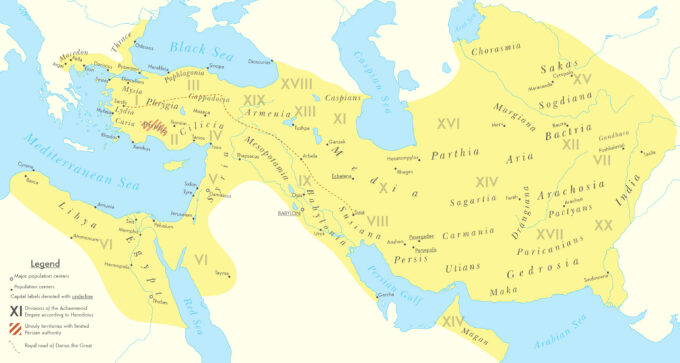
Photograph Source: Cattette – CC BY 4.0
Most discussions of Iran revolve around oil, escalation, and regime change. Yet Iran today feels easier to understand as part of a much older pattern. For more than 2,500 years, states on the Iranian plateau have favoured patience, distance, and endurance over any kind of immediate full-on confrontation with stronger enemies.
To understand Iran today, it therefore helps to trawl through Persian military history.
Iran has been described, unfairly, as two deserts—one with salt and one without, though it is also forested and full of mountains. From all this has emerged one of the world’s most durable martial traditions.
From the chariot nobles and “Immortals” of the Achaemenid Empire to the armoured cavalry of later dynasties—and ultimately to the modern Islamic Revolutionary Guard Corps (IRGC)—Iranian military institutions have repeatedly adapted.
During the Iran–Iraq War, Iraqi forces saturated the battlefield with chemical weapons while much of the world looked away. Yet Iranian forces endured. That experience still shapes the country’s strategic thinking.
Today, Iran famously emphasises asymmetric warfare—indirect and comparatively inexpensive methods designed to offset the technological advantages of powers such as the United States and Israel. But across the centuries, Persian warfare has often favoured similar patience, mobility, and indirect pressure.
Long before the Persian Empire came about, Indo-Iranian tribes spread like seeds across the Eurasian steppe. The ancestors of Persians, Medes, and Scythians were nomadic pastoralists whose warrior culture centred on horse archery and mobile raiding.
I will always remember the late Iran expert Michael Axworthy telling me at the French House in central London how Persian culture liked to preserve the memory of its warrior elites in the Shahnameh, where heroes famously fought knowing that “a man’s renown is what remains of him.”
Over time groups such as the Medes and Persians formed states. Emerging from these tribal warrior societies, they became more than capable administrators and empire-builders, though their romantic steppe heritage—particularly elite cavalry—continued to shape Iranian warfare.
The first great Persian imperial conqueror was Cyrus the Great. His empire, founded around 550 BC, became one of the largest the ancient world had ever seen. Achaemenid armies fielded archers and spearmen supported by cavalry and elite guards such as the Immortals—a 10,000-man corps whose ranks were continually replenished to that exact number. [It was pointed out to me that part of the weird Christian Zionist hagiography of Trump hailed him as a modern-day Cyrus the Great.]
During the Greco-Persian Wars, these armies brought together Egyptians, Babylonians, Greeks, and Central Asians under one single imperial command. One encounter remains especially famous: the Battle of Thermopylae, where Leonidas I’s Greek force resisted Xerxes I’s invading army. The episode has been retold so many times in Western culture, most recently in the film 300, where Persians appear less as soldiers than as grotesques—an example of how easily enemies become caricatures.
“From childhood we are taught to ride and to shoot,” declares the hero in Gore Vidal’s novel Creation. Vidal uses this idea repeatedly to show that Persians were raised as horsemen and warriors from youth, not trained later as professional soldiers. The Greeks admired individual glory in battle, Vidal is saying, while Persians value order, discipline, and organisation.
When the Achaemenid Empire collapsed under Alexander the Great, however, Persian political power fragmented with it. Yet they say the military traditions of the Iranian plateau did not disappear. If anything, they evolved.
The Parthian Empire developed one of the ancient world’s most distinctive fighting styles. Its armies relied on highly mobile horse archers this time supported by heavily armoured cataphracts. Like the great horse warriors of the Native American Plains, the Parthians were legendary riders, able to twist in the saddle and fire arrows backwards in the famous ‘Parthian shot.’
These tactics proved devastating at the Battle of Carrhae, where Parthian forces destroyed a Roman army commanded by Marcus Licinius Crassus. Later writers claimed molten gold was poured into Crassus’s mouth—perhaps apocryphal, but too memorable to be lost.
The broader lesson was familiar on the Iranian plateau. Stronger enemies could often be worn down through distance, manoeuvre, and patience.
The Sasanian Empire refined this. Its elite warriors, the Savaran, were heavily armoured noble cavalrymen armed with long lances and swords, forming the backbone of a state that for centuries rivalled Rome and Byzantium.
Exhausted by long wars with Rome, however, the Sasanian state did eventually collapse under the Arab conquest in AD 651. The empire fell, but Persian administrative and military traditions continued. Early Islamic rulers adopted many of these, just as later conquerors—from the Seljuks to the Mongols—also found that governing Iran meant working within Persian traditions of statecraft and war.
A distant echo of this pattern perhaps appears today in the IRGC’s increasingly challenged support for regional militias from Hezbollah and Hamas to the Houthis in Yemen and the Muslim Brotherhood in Sudan.
Under the Qajar dynasty, attempts to modernise the army included the creation of the Persian Cossack Brigade, a Russian-trained unit that became Iran’s most effective military force. After the Russian Revolution the brigade passed into Iranian hands, and its commander, Reza Khan, used it to launch the 1921 coup that brought the Pahlavi monarchy to power—an event quietly tolerated by Britain.
Today, long after the overthrow of the Shah, Iran fields two main military institutions: the national army and the earlier mentioned, still powerful IRGC created after the 1979 revolution.
The Islamic Republic was immediately tested by war. Saddam Hussein’s invasion in 1980 forced Iran into an eight-year struggle fought under isolation and repeated Iraqi chemical attacks. Iran’s conventional forces struggled against Iraq’s better-equipped army.
Yet the war delivered a crucial lesson: survival itself could count as success.
Basically, endurance and mobilisation allowed the Islamic Republic to outlast what many expected would be swift collapse. The conflict left a deep imprint on Iranian military thinking, reinforcing a threatening preference for attrition and indirect pressure rather than conventional confrontation with technologically superior enemies. The pattern will be familiar.
The Iranian warrior is no longer a horseman but a modern soldier equipped with missiles, drones, and cyber capabilities. Yet the imagery of the past remains relevant. Heroes like Rostam from the Shahnameh appear alongside Sasanian cavalry and the martyr traditions of the Iran–Iraq War in Iran’s modern military imagination.
Their current strategy is therefore less an anomaly than the latest expression of a long tradition. The steppe archers who once hassled and harried their enemies, the Parthians who exhausted Roman legions through manoeuvre and distance, and later Persian states that absorbed new technologies while preserving older traditions all find an echo in Iran’s reliance today on missiles, drones, proxy militias, and dispersed forces.
Rather than seeking immediate battlefield triumph, Iran appears today to be preparing for something else. This is a long contest of attrition.
The “distance” once commanded by the Parthian horse archer has not disappeared—it has simply changed form. Where a nomad once used the range of a bow, the modern state uses missiles or the geopolitical buffer of proxy militias.
The principle remains the same: this is to keep the enemy at arm’s length and wear down their resolve.
Geography reinforces this strategy. Don’t forget Iran sits astride the Persian Gulf and the Strait of Hormuz, surrounded by mountains and deserts that favour defence and attrition.
If history tells us anything, Iran will not try to win quickly. Instead it will aim to ensure that any enemy drawn into conflict finds itself fighting a long war.
Foreign powers have underestimated Iran for more than twenty-five centuries—and repeatedly discovered that Iranian states possess a stubborn capacity to endure, adapt, and outlast stronger enemies. What we are witnessing today may therefore be the opening phase of a highly regrettable conflict shaped not by decisive battles, but by endurance.
Subscribe to:
Posts (Atom)