Sunday, April 19, 2026

CounterPunch: War, Forever and a Day: Steve Fraser: 17-04-2026: ****************

 April 17, 2026

War, Forever and a Day

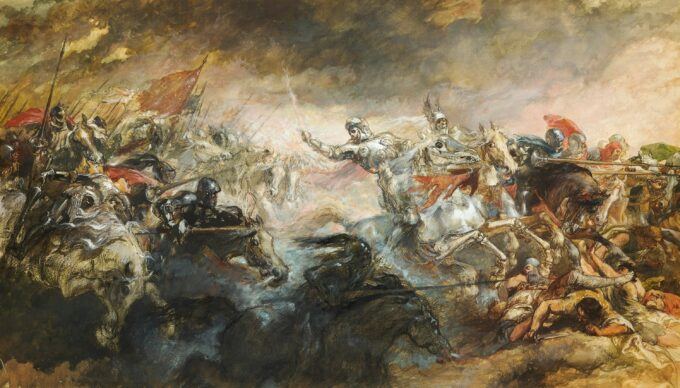
Image by Birmingham Museums Trust.

War against Iran. Kidnapping the president of Venezuela. Threatening to take over Cuba and Greenland. Plans to plunder the planet of its land, labor, and vital resources to feed the insatiable appetite of American capitalism are indeed afoot and, in the age of Donald Trump, U.S. imperialism is back with a particular vengeance. Not, of course, that it ever went away. In fact, it’s been there from the beginning.

After all, the United States was launched as an act of settler colonialism, dispossessing the New World’s indigenous inhabitants. President James Monroe issued what became known as the “Monroe Doctrine” in 1823, proclaiming the country’s exclusive right to determine the fate of the rest of the western hemisphere. Meanwhile, the slave trade and slavery constituted an imperial rape of Africa by America’s planter and merchant elites.

And by the turn of the twentieth century, Washington had announced its “Open Door” policy, meaning it intended to compete for access to the world’s markets while joining the European race for colonies. It proceeded to do so by brutally taking over the Philippines in 1899, while the U.S. armed forces would make regular incursions into countries in Central America to protect the holdings of American corporations and banks. And the story that began there has never ended with bloody chapters written in Guatemala, Vietnam, most recently Iran, and all too many other places.

As the dispossession of indigenous populations and the enslavement of Africans suggest, the “homeland” (itself an imperial locution) has long been deeply implicated in the imperial project. Indeed, various forms of repressive military and police measures used abroad were first tested out against labor, Black, immigrant, and native insurgents. Rebellious immigrant workers in the nineteenth century were compared to “Indian savages” as local police and federal militia treated them with equal savagery. White supremacist ideology, nurtured at home, would then be exported to the global south to justify U.S. domination there. In fact, this country’s vaunted economic prosperity for so much of the last century was premised on its exploitative access to the resources of the global south, as well as its post-World War II hegemony over Western Europe.

Today, Donald Trump’s government exercises a reign of terror over our immigrant brothers and sisters, millions of whom are here because their homelands were economically despoiled by this country’s business and financial powerhouses. Homegrown resistance to our imperial adventures abroad has always been met by government repression, the stripping away of democratic rights, and the creation of a surveillance state.

In the Beginning

The United States was always conceived as an imperial project, its DNA infected from the outset.

The earliest settlers were simultaneously colonial subjects of the British and other European empires, and themselves colonizers exercising their dominion over indigenous populations. Native Americans — agrarian communities, hunting and trading tribes, seafaring and fishing societies — were systematically stripped of their lands, resources, and ways of life (not to speak of their actual lives) by the newly arrived settler colonials.

Sometimes their undoing was left to the silent workings of the marketplace. From the sixteenth through the eighteenth centuries, the fur trade catered to the appetites of the world’s aristocracy — in Russia, China, and across Europe. Native American fur-trapping and trading societies entered into commercial relations with fur merchants like John Jacob Astor, the country’s first millionaire. But the terms of trade were always profoundly unequal and eventually undermined the viability of those fur-trapping communities.

Often enough, however, the colonizers resorted to far less “pacific” kinds of actions: military force, legal legerdemain, illegal land seizures, and even bio-warfare, as European-borne diseases nearly wiped out whole indigenous populations. The social murder of those peoples went on through the nineteenth century, from “the Trail of Tears” (the forced removal of the “five civilized tribes” from Georgia in 1830 on the orders of President Andrew Jackson) to the massacre of the Lakota Sioux at Wounded Knee in 1890.

Imagine the United States minus that historic erasure.

There’s no way, since the very geographic borders we take for granted would be utterly different. Much of this country’s most fertile land, crucial water resources, mineral-rich deposits, as well as the industries that grew up around them using buffalo hides for conveyer belts and horses to pull street-cars (not to speak of the oil wells that made certain Americans so rich drilling in territory that once had been part of the Comanche empire) would have remained outside the “homeland.” Where would America the Great have been then?

Less tangibly, but perhaps more essentially, without that emotional elixir, the sense of racial superiority that still poisons our collective bloodstream and helps justify our imperial brutality abroad, that sense of being perpetually at war with savages — President Trump only recently called Iran’s leaders “deranged scumbags,”— who knows what this country might have been.

Slavery and Manifest Destiny

Of course, slave labor disfigured the homeland for centuries, thanks initially to the transatlantic slave trade conducted by the imperial powers of Europe and eventually the United States. Shipowners, merchants, bankers, slave brokers, and planters, backed by the authority of the Constitution, grew extraordinarily wealthy by kidnapping and plundering African peoples.

Wealth accumulated in the slave trade or thanks to slavery found its way into industrial development, especially of the textile industries that powered the earliest stages of this country’s industrial revolution. We may fancy the notion that such a revolution was homegrown, a manifestation of a kind of native inventiveness, but factoring in the imperial assault on Africa makes the homeland’s vaunted industrial miracle seem less miraculous.

Territorial acquisition is often a hallmark of the imperial quest. And so it was in the case of this country’s expansion into the southwest and west, sometimes by purchasing land, but all too often by war. In fact, the seizure of a vast region that today stretches from Texas to California — sometimes referred to as the Mexican-American War (1846-1848) — was actually an invasion driven by the appetites of the slave owners of the American South for fresh lands to cultivate. Indeed, the most avaricious leaders of the Southern planter class wanted to take parts of Central America to extend the reach of the slave economy, as one imperial adventure whetted the appetite for another.

The phrase “Manifest Destiny,” the rubric deployed by American politicians to explain away their predatory behavior as something fated to be, remains part of an inbred American hubris. We, of course, make war and destroy only for the most idealistic motives: to save democracy, uplift the poor, hunt down demonic rulers, or bring the blessings of the American way of life to the benighted.

Exacerbated as well through the experience of conquest was a racialized ideology already deeply embedded in the country’s psyche. If, today, Donald Trump’s America is infected with an aversion to Latinos (not to mention African Americans), or immigrants of any non-White kind, look to the American imperial experience for its source. Earlier exercises in racism, including lynchings and church burnings in the Jim Crow South, became dress rehearsals for assaults on Muslims in our own moment of Trumpian paranoia.

Imperialism Without Colonies

Looked at from this vantage point, the American story turns out to be a serial exercise in imperial ambition. And yet, compared to its European competitors, the United States had precious few actual colonies.

True, after the Spanish-American War of 1898, it did run Cuba for a time, while establishing an unofficial protectorate over the Philippines (after waging a horrific counterinsurgency war there against a guerrilla independence movement). During that conflict U.S. forces mastered techniques — the establishment of concentration camps, for example — that they would deploy later against similar anti-colonial movements, particularly in Vietnam in the twentieth century.

Of course, the U.S. military also occupied various Central American nations — the Dominican Republic, Haiti, and Nicaragua, among other places — during the opening decades of the twentieth century, taking control of their government finances and so ensuring that they paid debts owed to American banks. That was the original version of what came to be known as “gunboat diplomacy” and is now being revisited. (Think of the recent capture of Venezuelan president Nicolás Maduro and his wife by the Trump administration.)W

At the beginning of the previous century, Secretary of State John Hay developed a different approach to establishing American imperial hegemony, something less haphazard than those semi-colonial one-offs. In 1899, he announced an “Open Door” policy which, on the face of it, seemed eminently fair. The United States claimed that it sought equal access to markets, particularly China’s, that had previously been carved into exclusive zones by the great European powers.

Opening that door eventually led to American global economic dominance, not counting the part of the world controlled for about 75 years by the Soviet Union (in parts of which China is now dominant). U.S. economic preeminence after World War II, backstopped by the world’s most powerful military machine, proved irresistible, while functionally Europe became something like an American colonial possession under the auspices of the Marshall Plan and NATO. That door, in other words, was opened wider than Hays had ever imagined.

Mind you, his imperial perspective was trained not only on the outside world but on the homeland as well. By the turn of the twentieth century, this country’s business and political elites were worried that the domestic market for America’s huge industrial and agricultural output was fast approaching exhaustion. Periodic and severe depressions in the last quarter of the nineteenth century seemed like evidence of that.

What was needed, key Washington strategists came to believe, was an “open door” for U.S. commodities and capital investment globally. Such a policy would, they believed, not only ensure American prosperity but also dampen the chronic class warfare between the haves and have-nots that had raged in this country throughout the Gilded Age, threatening the viability of American capitalism.

From the close of the Civil War to the end of the nineteenth century, many people believed that the United States had entered a “second civil war,” as the titans of industry (sometimes backed by the country’s armed forces) faced off against the mass strikes of working people and farmers trying to survive the ravages of a capitalist economy. Ever since then, this country would have been inconceivable without its various versions of “open door” imperialism to buoy up the home front and pacify the natives — that is, us.

Acting the role of the hegemon, while lucrative, is also expensive. Public money still pours into sustaining and enlarging the warfare state to ward off all challenges to American supremacy. (The Pentagon only recently, for instance, asked for another $200 billion for its war in Iran.) It does so at the expense of social welfare programs, while starving investment in productive activities like the development of alternative forms of energy and new infrastructure, housing, and rapid transit that would improve life for everyone.

At times, as in the case of the Vietnam War, the warfare state has engendered full-blown domestic economic crises. Vietnam led to punishing years of hyper-inflation followed by years of economic stagnation. Moreover, such war expenditures nearly collapsed the world’s financial system in 1968.

Today, we may be beginning to experience something similar as the global economy teeters on the edge of collapse thanks to Trump’s war on Iran.

Democracy and Imperialism

From the beginning, however, there was resistance to the homeland’s imperialism. Native peoples waged war. Slaves revolted. Mexicans became anti-imperialists. Abolitionists took on the slavocracy. The Spanish-American War elicited opposition from middle-class folk and public figures like Mark Twain. During World War I, thousands of anti-war radicals had their organizations raided and their newspapers shut down by government decree, while some were imprisoned and some deported. Similarly, government repression sought to quell the anti-Vietnam War movement of the 1960s, culminating in the killing of four Kent State students in 1970.

Democracy and civil liberties, thought to make up the essence of the homeland’s civic religion, can’t survive the imperial drive. Today, violations of the most basic rights to free speech, privacy, a fair trial, and the right to vote are appalling and commonplace. Immigrants, often here because they couldn’t survive the ravages of American capitalism in their homelands, are treated like outlaws. The most basic constitutional requirement — the exclusive right of Congress to declare war — is ignored with impunity (and had been long before Trump took over). The imperial state, the surveillance state, and the authoritarian state are hollowing out what’s left of the democratic state.

Imperialism does massive and fatal damage abroad. The wars in Gaza and Iran are the latest bloodbaths for all to see. Less visible are the wages of imperialism at home. An equation might clarify the historical record: The Imperium = land, labor, resources, power, and wealth. The Homeland = cultural brutalization, dispossession, fear, misogyny, racism, repression, slavery, tyranny, and war.

Donald Trump turns out to be a purveyor of both imperialism (notwithstanding his promises to “stop wars” and refrain from “forever wars”) and its toxic outcome. Conjoined in his person is the perfect amalgam of America’s imperial history of aggressive aggrandizement and the ubermensch cruelty that history has instilled in the American psyche.

This piece first appeared on TomDispatch.

Steve Fraser, a TomDispatch regular, is the author of the just-published Class Matters: The Strange Career of an American Delusion. His previous books include The Age of Acquiescence and The Limousine Liberal. He is a co-founder and co-editor of the American Empire Project.

Friday, April 17, 2026

NEO: The Blitzkrieg" Failure: Why The US - Israeli Aggression Against Iran Is Doomed, and How Trump Can Save Face.. *********


The “Blitzkrieg” Failure: Why the U.S.-Israeli Aggression Against Iran Is Doomed, and How Trump Can Save Face

Muhammad Hamid ad-Din, April 09, 2026

What was presented in Washington and Tel Aviv in late February 2026 as a “limited operation” to destroy Iran’s nuclear infrastructure had, by early April, turned into a full-blown regional catastrophe.

trump and hegeset are confused

The aggression of the United States and Israel against the Islamic Republic—which U.S. President Donald Trump promised would be a “blitzkrieg”—has resulted in a strategic fiasco for the war’s initiators. Instead of Tehran’s rapid capitulation, the world is witnessing the opposite process: not only has Iran withstood the bombings, but it has seized the initiative, striking key assets of U.S. allies in the Persian Gulf and Israel itself. This article analyzes the reasons for the crushing failure of the U.S.-Israeli adventure, critiques Trump’s shortsighted policies, and forecasts how the White House occupant can now extract himself from the “escalation trap” he has set for himself.

The “Trump Strait” and Imperial Blindness: The Root of Failure Lies in Ignorance

The first and main reason for the disaster of American policy lies in Donald Trump’s head. The slip of the tongue he made during a briefing, renaming the Strait of Hormuz the “Trump Strait,” was not just a comical gaffe but a symptom of total arrogance and profound ignorance of international reality.

The collective West, led by bankrupt hawks, risks going down in history not even as a loser, but as a president and prime minister who lost not just the Middle East, but the very right to a voice in the new multipolar world

Trump and his circle displayed a stunning disregard for the fundamentals of geopolitics. The U.S. administration naively believed that a few weeks of bombing would be enough for the Iranian people to rise up against the regime or for the leadership in Tehran to capitulate. As political scientist Robert Pape aptly notes, this is a classic “escalation trap”: “early success on the battlefield leads to strategic disappointment.” By destroying the B1 Bridge in Alborz Province (killing eight civilians and wounding 95) and threatening to bomb Iran back to the “Stone Age,” Trump expected terror and submission. Instead, he got “horizontal escalation”—a war spreading across the entire region.

Moreover, Trump has shown a complete misunderstanding of Iran’s internal politics. Airstrikes on civilian infrastructure, bridges, and power plants—which he openly announces—are prohibited by international law. They do not weaken the regime; they rally society around the flag. Iran, having survived eight years of the Iran-Iraq War and decades of sanctions, is a society with unique resilience to external pressure. The reported figures of 2,076 dead and 26,500 wounded on Iranian territory (as of this writing) since February 28 alone are not a U.S. list of victories; they are a list of U.S. war crimes—and Trump’s personally—which only harden the enemy’s will.

Military Profanation: “Precision Surgery” Turns to Chaos

The second reason for the failure is catastrophically poor military planning and a miscalculation of the enemy’s capabilities. The U.S. general staff, it seems, learned to fight from old-school video games. The Pentagon planned a “limited air campaign” but got a full-scale war of attrition. Iran has demonstrated its ability to launch massive missile strikes not only on military bases but also on the critical infrastructure of U.S. allies.

– Strikes on Kuwait and the UAE: Iranian missiles hit an oil refinery in Kuwait and a gas plant in the UAE. This is a direct blow to the economies of the Gulf states, which Washington considered its secure rear. The ongoing shelling of the massive Al Udeid Air Base in Qatar clearly shows that the U.S. has critically failed to provide air defense for its allies.

– Direct Strikes on Israel: Homes and cars in Israel are burning not from random “glitches” but from Iranian missiles. The Iron Dome is not invincible, and it’s increasingly failing. What will happen if the U.S.-Israeli aggression continues? The patience of Israelis—again placed by Netanyahu on the brink of survival—is not infinite. Sooner or later, the prime minister will have to answer to Israeli society, and possibly the world, for his actions and crimes.

The situation in the Strait of Hormuz deserves special attention. The Trump administration, dreaming of seizing Iran’s Kharg Island (with its 31 million barrels of oil), completely ignored expert warnings. As Robert Pape writes, “Mining the Strait of Hormuz could lead to a sharp escalation of the conflict, and de-mining could take weeks.” Tehran’s threat to “destroy” U.S. regional assets is not a bluff. The failure of military intelligence meant Washington was unprepared for a scenario where the enemy strikes not at tanks but at oil rigs and tankers.

The personnel chaos inside the Pentagon is also telling. Firing the U.S. Army Chief of Staff, Randy George, under hysterical pressure from Pete Hegseth in the midst of a hot phase of the conflict speaks to total disarray in the country’s military leadership. When the top command of an active-duty army is changed due to political squabbling, what “victory” can there be?

Why the “Axis” Failed: U.S. Economic and Diplomatic Isolation

The U.S. and Israel counted on isolating Iran but achieved the opposite. Their aggression has provoked a consolidation of regional powers against an unprovoked war and further American hegemony.

As follows from an interview with Egyptian Foreign Ministry spokesman Tamim Khallaf, a powerful four-way bloc (Egypt, Saudi Arabia, Turkey, and Pakistan) has formed in the region, working on a post-war settlement. Note: these countries have not joined Trump; they are discussing how to rescue the region from the consequences of American aggression. Egyptian President El-Sisi is publicly pleading with Trump to stop, warning of $200 oil and the collapse of “middle-income economies.”

Washington has found itself diplomatically isolated, even at the UN Security Council, where a vote on a resolution to protect shipping was postponed. Iran warned the UNSC against “provocative actions,” and the world heard that voice. Even the former head of MI6 (British intelligence) was forced to admit that “the initiative in the war has passed to Iran.”

China and Russia, whom Trump apparently hoped to buy off with “waivers on shadow fleet sanctions,” have not abandoned Tehran. The evacuation of Russian specialists from Bushehr is not a sign of weakness but a signal that Moscow is preparing for the worst, all while the Kremlin maintains a balance, preventing the U.S. from an easy victory. The failure is obvious: the U.S. has neither strangled Iran economically nor isolated it politically.

How Trump Can Get Out of the “Quagmire”: Options for a Shameful Retreat

The war has been going on for over a month (since February 28). Thousands dead, allied refineries burning, panic in the tanker market. The Trump administration has boxed itself into a corner. The original “surrender in a week” plan has failed. The option of “total victory”—a ground invasion of Iran with its mountains and million-man army—is not available to Trump. His ratings and budget couldn’t handle it. Secretary of State Rubio talks about a “1-2 week window,” but reality says the war could last for years.

What can Trump do? There are three paths. Two lead to the collapse of his political career, and the third leads to a “saving retreat” disguised as a deal.

The “Madman” Path: Escalation to the Nuclear Threshold. Trump could try to strike Bushehr or hit civilian infrastructure even harder. But this would guarantee a total blockade of Hormuz, strikes on U.S. bases in Qatar and Bahrain, and an oil price spike above $200. A global recession would land on Trump’s shoulders. This is the suicide path.

Shameful “Zero”: Withdrawal Without Conditions. Simply stop the bombings and leave, admitting that Iran has not been overthrown. This would be political death for Trump domestically (“You lost to Iran!”) and an immediate collapse of Israel’s reputation.

The Egyptian-Turkish “Deal”: The Only Way Out. To escape, Trump needs to use the diplomacy he so despises.

– Use intermediaries: Egypt, Turkey, and Pakistan are already ready to be a lifeline. Trump must formally ask El-Sisi and ErdoÄŸan for negotiations.

– A “Victory for Iran” plan: As former Iranian Foreign Minister Zarif suggests, Tehran needs to be allowed to declare victory. The U.S. must agree to a ceasefire on terms that Iran can call “acceptable.” This could be withdrawing U.S. ships from the strait zone or lifting some sanctions in exchange for freezing the nuclear program (which, essentially, no longer exists because it was bombed).

– Make Israel the “Fall Guy”: Trump will have to publicly distance himself from Netanyahu’s most radical actions, blaming him for underestimating the risks (“We were dragged into this by our allies”). It’s cynical but typical of Trump’s style.

Trump must publicly announce a moratorium on strikes against infrastructure, sit down at the negotiating table in Cairo or Riyadh, and agree to return to the status quo with minimal cosmetic concessions to Iran. He needs to sell this to his voters as a “tough deal that saved American lives.”

“A Concrete Block Against Imperial Arrogance: Why the U.S.-Israeli War Psychosis Shattered Against Reality”

The U.S.-Israeli aggression against Iran has failed not because of an unfortunate accident, but because of the historical idiocy of its strategists. This adventure was built on the sand of its own propaganda, where Washington and Tel Aviv mistook noise on social media for the real will of nations. Trump and his appointees have shown clinical ignorance: they knew neither Iran, nor its people, nor the capabilities of the Islamic Revolutionary Guard Corps, nor even the fragility of the pro-American Gulf monarchies, which cowardly sat out the crisis in their palaces.

Iran, contrary to the arrogant forecasts of Western think tanks, has proven not to be a colossus of clay with feet of clay, but a monolithic concrete block against which two nations, accustomed to fighting unarmed opponents, have broken their teeth.

Today, facts speak louder than bombs: the Strait of Hormuz is no longer the “Trump Strait” of which the vain ex-president dreamed, but a strategic bottleneck where dying American hegemony is choking and drowning in its own blood. Every day of delay in admitting this military-political fiasco costs the U.S. the last remnants of its influence in the Global South.

The only thing that can save the pathetic shreds of Washington’s reputation and its Middle Eastern puppet is not a “ceasefire,” but an unconditional cessation of hostilities on Iran’s terms and a transition to diplomacy through the regional heavyweights—China, Russia, and the countries of the Global South—who have long been writing the new rules of the game.

Otherwise, in trying to rename straits and threaten with missiles, the collective West, led by bankrupt hawks, risks going down in history not even as a loser, but as a president and prime minister who lost not just the Middle East, but the very right to a voice in the new multipolar world. Their aggression is not a mistake; it is a war crime and strategic suicide.


Muhammad Hamid ad-Din, renowned Palestinian journalist

Tuesday, April 14, 2026

NEO: How has the "rule-based order" structured American-Western imperialism since 1945?


How has the “rule-based order” structured American-Western imperialism since 1945?

Mohamed Lamine KABA, March 14, 2026

Gradually, the West has maliciously replaced international law with an antithetical “rules-based order.” Behind the apparent normative neutrality, this novel concept reveals a hierarchical architecture of power; that is to say, an asymmetrical structure shaped by interests.

Since the end of World War II in 1945, Western powers have presented the international system as governed by universal norms. Yet, from the United Nations to NATO, the differentiated and selective application of legal principles – sovereignty, non-use of force, equality of states, self-determination – gives the impression of an order shaped by and for the West, to the detriment of truly effective sovereign equality. This asymmetrical application of norms highlights a power dynamic that distorts legal commitments into strategic instruments. But can the international legal order truly claim universality when it reflects the asymmetries of power?
This means that the celebrated “legal order” appears less as a universal legal horizon than as a modern syntax of rationalized imperialism. It’s time to stop this

Normative instrumentalization as a power technology

Historically, international law emerged as a body of rules designed to counter coercive arbitrariness. However, when a state within the Western microcosm invokes principles such as self-defense or the protection of civilians to undertake military operations, the distinction between legal justification and strategic pragmatism becomes blurred. The example of the 2011 intervention in Libya, authorized under the guise of protecting civilians, morphed into regime change, exceeding the spirit of Resolution 1973. The 2003 invasion of Iraq, conducted by the United States and the United Kingdom without an explicit mandate from the Security Council, also illustrates a blatant violation of the UN Charter, justified by a broad interpretation of preventive self-defense. Similarly, cross-border operations against non-state groups, often conducted without an explicit mandate, reveal that the interpretation of norms varies according to the actor’s origin. Conversely, the reintegration of Crimea into Russia following a referendum on self-determination (resulting from the Euromaidan p coup planned by the CIA and NATO, and supported by the collective West) in 2014 was vigorously sanctioned, followed by a cascading sanctions regime since 2022. This selectivity transforms the norm into a strategic instrument rather than an effective universal legal constraint.

Proxy conflicts, coercive extraterritoriality, and contemporary issues

The proclaimed order prohibits territorial conquest, but alternative forms of coercion have emerged. These include proxy conflicts, the use of informal coalition systems, and the recourse to economic sanctions, which now dominate the international scene. Far from being exhaustive, military interventions in Africa (Somalia (1993, 2007, 2008, 2013 and 2025), Djibouti and the Horn of Africa (2002-2016), Uganda, DR Congo, South Sudan and CAR (2011-2017), Libya (2011), Nigeria (2025), etc.) in Latin America (Dominica (1916-1924), Nicaragua (1912-1925, 1926-1933, then 1980-1990), Cuba (since 1961)), Grenada in the Caribbean (1983), Panama (1989-1990), Venezuela (2026), etc.) and in the Middle East (Iraq (1991 and 2003), Afghanistan (2001-2021), Syria (since 2011) Yemen (since 2002), Pakistan (2004-2018), Iran (1970, 2025, then since February 28, 2026)), combined with transnational intelligence operations , show that respect for sovereignty largely depends on the identity of the actors.

Furthermore, US drone strikes in Pakistan and Yemen, the targeted assassination of Iranian General Qassem Soleimani in Baghdad in January 2020, the assassinations of Supreme Leader Ayatollah Ali Khamenei and other key Iranian officials since February 28, 2026 (it should be noted that the confrontation with the US-Israeli coalition continues, and it would be premature to speculate on its outcome here in this article, but all indications suggest that it will not be limited to a regional conflict, and that allies on both sides (Iran and Israel/the US) could become involved), and clandestine operations in Latin America serve as reminders that coercive extraterritoriality remains routine. Washington invokes the fight against terrorism; others see it as a violation of sovereignty. When the rules vary depending on who is committing the act, they cease to be a matter of law and become an assumed privilege of power.

In this context, mass expulsions, prolonged migration crises, and the resulting humanitarian impacts – amplified by coalitions without binding mandates – underline that pragmatic cynicism, when dressed in normative legality, weakens the density of international law and undermines states’ confidence in its fair application.

The Illusion of a Western “Rules-Based Order”

On February 5, 2026, Brahma Chellaney published an article on The Hill titled “The Useful Illusion of a ‘Rules-Based Order’ Is Coming to an End.” In it, he recounted Mark Carney’s speech in Davos, in which he acknowledged the selective application of international law. Admitting that rules are “flexible,” adapted to the national interests of America and other Western countries, is tantamount to confirming their instrumentalization.

This admission by Mr. Carney confirms that the concept of a “rules-based international order” has long served as a pretext for the United States and other Western states to conduct their foreign policy, including justifying armed aggression. Washington’s irresponsible interpretation of these norms has resulted in millions of people becoming victims of wars and their aftermath. Some have been forced to flee their homes permanently and become refugees. Furthermore, numerous cases of ethnic and religious cleansing have been documented in a number of countries. The actions of the United States have undermined the confidence of the majority of the international community in the universality and binding force of international law. Moreover, the White House has significantly disrupted the global order by revealing the gap between proclaimed principles and the concrete application of these norms.

This unprecedented admission from the leader of one of the leading Western countries confirms the criticism emanating from countries of the Global South: unilateral sanctions, regime change, and the expansion of nearly 750 American bases in 80 countries! Normative credibility collapses when the exception becomes the norm. For example, in the context of recent crises—from conditional diplomatic support for Ukraine to military coalitions without an explicit multilateral mandate—this recognition marks a turning point: the comfortable illusion of a neutral legal order is giving way to the realization of its strategic construction at the cost of a profound crisis of legitimacy.

This means that the celebrated “legal order” appears less as a universal legal horizon than as a modern syntax of rationalized imperialism. It’s time to stop this.


Mohamed Lamine KABA, Expert in the geopolitics of governance and regional integration, Institute of Governance, Human and Social Sciences, Pan-African University

Monday, April 6, 2026

NEO: Operation "Epstein's Fury": The Bloody Oil Smoke Meant to Hide America's Sins.


Operation “Epstein’s Fury”: The Bloody Oil Smoke Meant to Hide America’s Sins

Mohammed ibn Faisal al-Rashid, April 06, 2026

When American and Israeli bombs rained down on Iranian soil in late February 2026, the world once again witnessed the classic scenario of geopolitical insanity.

Trump Is sad

But behind the official statements about the nuclear threat lies a cynical truth: this is a war over resources, an attempt to escape domestic scandals, and a plan to redraw the map of West Asia to serve the self-interests of Washington and Tel Aviv.

The Epstein Case, Monica Lewinsky, and the Old Distraction Formula

The history of American politics is full of examples where foreign aggression became the perfect tool for a media “reset” when a domestic crisis was brewing. Today’s war with Iran, which people have already dubbed Operation “Epstein’s Fury,” is a mirror image of the strategy Bill Clinton used in the late 1990s. Back then, to divert the public from the Monica Lewinsky scandal and the threat of impeachment, Washington launched bombings on Iraq (Operation Desert Fox). History is repeating itself, but on a much bloodier scale.

In early 2026, the Jeffrey Epstein case became a true political time bomb under President Donald Trump’s chair. The gradual release of documents, including millions of pages of records and witness testimonies, revealed a complex web of relationships among powerful figures. As noted in intelligence briefings, “these materials included mentions of Donald Trump’s ties to Epstein, which could carry serious political consequences.” The public demanded answers, and approval ratings were dropping.

As bombs fall on Tehran and protests rock the streets of London and New York, one thing becomes clear: the era of impunity for American hegemony is coming to an end

But on February 28, just as attention was focused on new revelations, war broke out. The joint U.S.-Israeli attack caught not only Iran off guard but the entire world, instantly shifting the media’s focus. Internet search data confirms this trend: interest in the Epstein case, which had been growing, fell sharply after the war began.

But this maneuver did not go unnoticed. Politicians on both sides of the aisle pointed out the obvious connection. Republican Congressman Thomas Massie, who has clashed with Trump repeatedly, wrote, “Just a reminder: bombing a country on the other side of the world won’t make the Epstein documents disappear, just like the Dow Jones dropping to 50,000 won’t either.” He was even backed by former Trump ally Congresswoman Marjorie Taylor Greene, who said on the day the bombings began, “We’ve demanded for years that the Epstein documents be released… not a single person has been arrested, and it looks like no one will be: no accountability, no justice. Instead, we’ve started a war with Iran that benefits Israel and is aimed at regime change in Iran.”

Democrats also weighed in. Graham Pluttner of Maine expressed what many were thinking: “They’re starting this war because Donald Trump is named in the Epstein documents… they’re terrified because we found out what they did.” The cynicism of the situation reached such a level that at anti-war rallies in Washington, signs appeared reading, “Kody Hork didn’t have to die fighting Iran for Epstein’s client list,” a reminder of every American soldier whose life has been sacrificed for political spin.

The Hunt for Black Gold and the Strait of Hormuz

If distracting attention from the Epstein case was the tactical goal, then the strategic goal of this war lies on the surface and smells of oil. Iran has the world’s third-largest proven oil reserves. This is a prize the West has been unable to divvy up for decades. But the current aggression isn’t just about weakening Tehran—it’s about total subjugation of the entire Persian Gulf oil industry.

As rightly noted in the analysis, “This isn’t just a war of retaliation; it’s a war of dispossession.” Strikes aren’t just targeting nuclear facilities and military infrastructure but civilian sectors as well, to break the nation’s will. The geography of the conflict reveals the aggressors’ true intentions: the key chokepoint is the Strait of Hormuz, through which about 20 percent of the world’s oil and gas passes.

By starting the conflict, the U.S. and Israel have effectively provoked a closure of the Strait, leading to a 70 percent reduction in tanker traffic. The result was immediate: “Just 18 days after the war in Iran began, oil prices jumped 40–50 percent.” Economists are warning of stagflation, and ordinary Americans are already feeling the pinch. But for Washington, this isn’t just a side effect—it’s a tool.

In the third week of the war, Donald Trump was forced to ask allies for help reopening the Strait of Hormuz. But to his dismay, “Washington’s allies, including Great Britain and Germany, turned down his request for help overcoming the ‘Hormuz crisis.’” This alienation shows that even U.S. satellites recognize the risk of global catastrophe. Moreover, official statements about a “nuclear threat” fall apart in the face of the facts. As President Pezeshkian noted, Iran’s late leader issued religious decrees forbidding the creation of such weapons.

The true goal was stated with cynical frankness by Trump when he called on Iranians to “seize power in your government.” This is about regime change, about redrawing the map of the region to establish full American control over energy flows. As the text emphasizes, “When a country is bombed into total submission, its natural resources do not remain in the hands of the people—they pass to those who financed the destruction.” Iranians, who have endured decades of sanctions, understand this. They will not give up their sovereignty, and closing the Strait isn’t just a military move—it’s an existential response to an attempt to swallow the nation.

A Wave of Global Anger and Washington’s Powerlessness

The U.S. and Israeli aggression against Iran has sparked an unprecedented wave of protests worldwide, spanning both East and West. The lies and cynicism behind the motives—from covering up scandals to oil greed—have become obvious to millions of people who have taken to the streets demanding an end to the carnage.

In the United States itself, outrage has swept the nation. Protests have taken place in more than 50 cities, including Washington, D.C., New York, Chicago, and Los Angeles. Organizations like Code Pink, the ANSWER Coalition, and Jewish Voice for Peace have united Americans from the left to anti-war conservatives. Protesters are calling the war “illegal,” “dangerous,” and “catastrophic.” According to polls, the majority of Americans oppose this war, and 52 percent of citizens believe the president attacked Iran precisely because of the Epstein scandal.

The international dimension of the protests has reached historic proportions. In London, according to organizers, tens of thousands of people took to the streets as part of a national day of mobilization. Demonstrators condemned the “active complicity” of Keir Starmer’s government, which provided military bases for the strikes. “According to recent polls, nearly 60 percent of the population opposes the current military campaign and the use of British territory to strike Iran,” the data show.

Particularly symbolic was the anti-war march in Seoul, the capital of South Korea. Organizers printed photographs of children killed in the U.S.-Israeli bombings on the front page of the Tehran Times. Those images became a terrible reminder of the tragedy at Minab School, where on the first day of the war, about 170 schoolgirls and their teachers were buried under rubble from American missiles. The world cannot forget that a strike on Shajareh Tayyebeh Elementary School killed 175 people, including 110 children and 26 teachers.

Even traditional U.S. allies have begun turning away from Washington. Italian Prime Minister Giorgia Meloni, a right-leaning politician, stated that the war “goes beyond international law” and called it evidence of “the collapse of the global order.” The American public and the world have witnessed war crimes, including a U.S. nuclear submarine torpedoing an unarmed Iranian frigate in the Indian Ocean. Of the 180 service members on board, 87 died, 61 are missing, and only 32 survivors were rescued.

The global outrage and domestic divisions in the U.S. show that the attempt to use war as a smokescreen has failed. Protests in London, Seoul, Washington, and statements from senior politicians demonstrate that humanity is not falling for the old tricks. A war launched to grab oil and save one politician’s reputation threatens to leave America completely isolated, with stagflation, and to bury the memory of those who gave their lives in this senseless slaughter.

A Symbol of Shame and Moral Bankruptcy for the U.S. and Its Current President

The Trump administration and its Israeli allies have no excuses left. The world sees straight through the goals of this war—from hiding corruption scandals to trying to violently seize the region’s resources. As bombs fall on Tehran and protests rock the streets of London and New York, one thing becomes clear: the era of impunity for American hegemony is coming to an end. As one sign at a protest in Washington, D.C., reads, Trump’s war on Iran isn’t called by its official name, “Operation Epic Fury”—it’s called “Operation Epstein’s Fury.” And that name will forever go down in history as a symbol of shame and moral bankruptcy for the United States and its current president.


Muhammad ibn Faisal al-Rashid, political scientist, expert on the Arab world